Pemantauan Perdagangan AfCFTA — Bukti ing Siji Pandangan
The African Continental Free Trade Area links 55 member states into the largest free trade area in the world by membership. But the small enterprises and cooperatives actually moving goods across those borders report performance annually, if at all — and every member state reports in its own format, on its own cycle, with no shared evidence standard underneath.
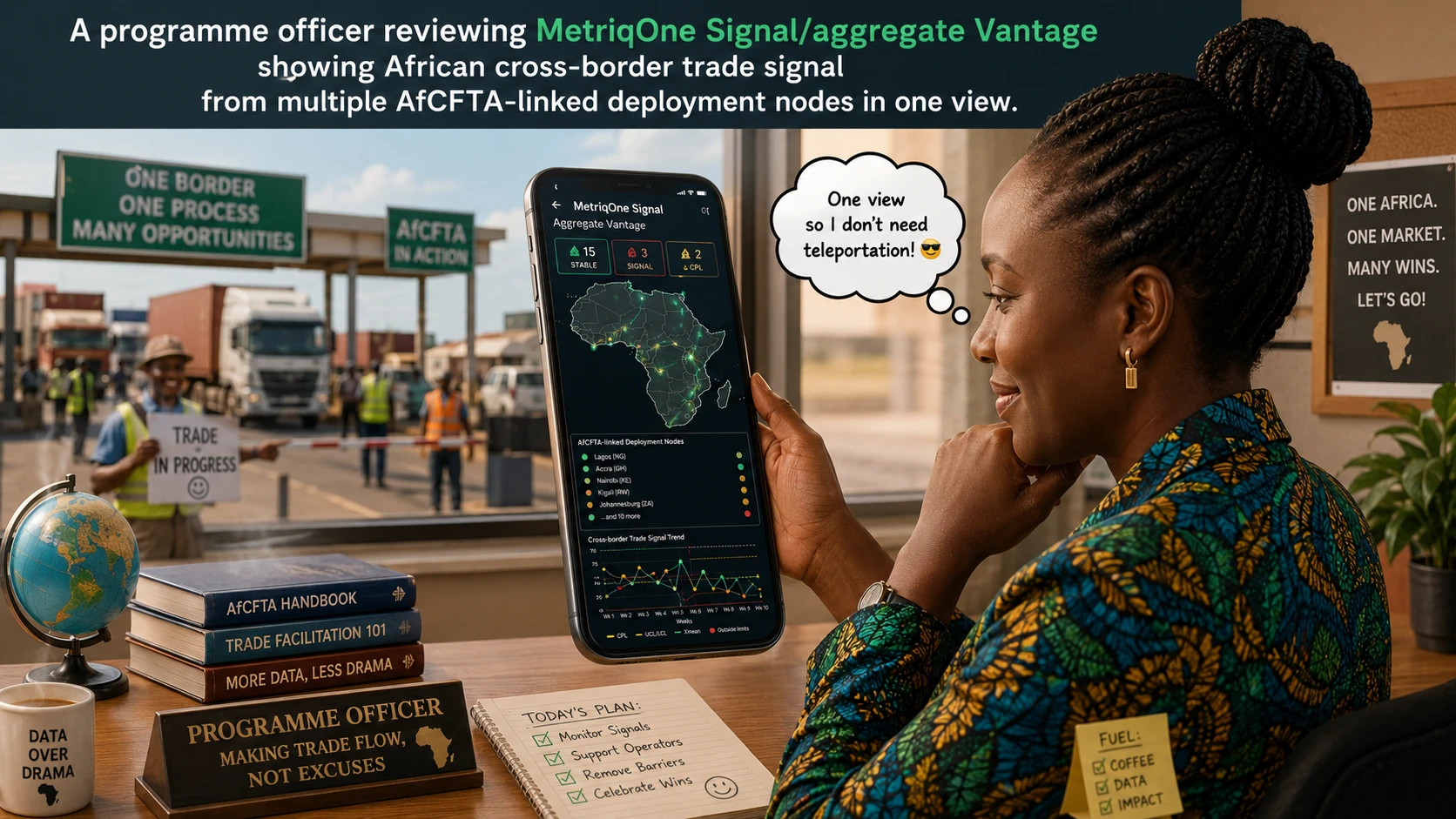
Aggregate Vantage does not ask member states to change how they report. It reads CRI convergence from Organisation and Cooperative tier nodes directly — the same measurement standard at every node, regardless of which member state it sits in — and shows a programme officer one evidence layer across every deployment simultaneously.
Jurang Antarane Ambisi Perdagangan lan Bukti Perdagangan
Kanggo petugas program lan pengelola dana
A disbursement or a trade-facilitation decision that touches three or four member states currently means reconciling three or four separate reporting formats, on three or four different cycles, each self-reported by the node itself. There is no single point where someone can see whether cross-border trade activity is actually stable, growing, or quietly failing — only a stack of annual claims that arrive too late to act on.
Kanggo UMKM lan koperasi sing dagang ngliwati wates
The enterprises actually doing AfCFTA-linked trade are asked to produce proof of consistent, verifiable activity for financing, customs, or bulk-buyer negotiations — and most have nothing but a notebook and a bank statement to offer. The evidence a lender or a trade partner wants and the evidence the enterprise can actually produce are not the same thing.
Both sides are missing the same layer: a field-level evidence standard that is identical no matter which member state the node sits in, read in one place instead of reconciled after the fact.
Kepiye Aggregate Vantage Maca Sinyal
Aggregate Vantage does not average data across countries or produce a single blended number. It reads each node's own CRI convergence and shows every node, named, in one evidence layer.
Ing ngendi bukti perdagangan dijupuk
Organisation and Cooperative tier nodes capture field-level activity — paper form and QR submission, offline-capable — the same standard whether the node is a solo trader or a cooperative, and regardless of which member state it operates in.
Ing ngendi Aggregate Vantage maca ing antarane node
CRI convergence — confirmation from at least 2 of 3 signal modules — is read from every AfCFTA-linked node simultaneously. Each node's status stays visible on its own; nothing is blended into a single continental figure that hides which node is actually driving a result.
Ing ngendi petugas program tumindak
A programme officer monitoring trade activity across several nodes sees which specific node is outside its confirmed range — a name, not a colour on a blended chart — before an annual report would have surfaced it at all.
Lima Sub-Wilayah, Siji Standar Koridor Perdagangan
AfCFTA-linked trade activity looks different in each sub-region — different goods, different corridor infrastructure, different dominant trade patterns. The evidence standard underneath stays identical everywhere; only the shape of what gets captured changes.
Afrika LorAMU
Established manufacturing and processing trade routes into Sub-Saharan corridors. The verification need here is consistency across a longer, more industrialised supply chain — CRI convergence at each handoff point rather than one enterprise-level reading.
Afrika KulonECOWAS
The highest concentration of AfCFTA-linked MSME and cooperative trade activity on the continent, much of it informal-economy adjacent. Cooperative tier registration — one TIN, one collective evidence chain — fits this shape directly.
Afrika TengahECCAS
Trade corridors here are the least continuous of any sub-region — nodes go quiet and resume as access and conditions change. Deactivation never deletes, so a node that pauses does not lose its evidence history when trade activity resumes.
Afrika WétanEAC · IGAD
Two overlapping regional bodies and some of the most mature mobile-first field operations on the continent, which makes this sub-region the strongest fit for smartphone-based QR submission alongside paper-compatible fallback where connectivity is inconsistent.
Afrika KidulSADC
The most developed cross-border digital payment backbone of the five sub-regions — the natural proving ground for reading full CRI convergence across several nodes in near-real time, with the least infrastructure compensation required anywhere else.
Apa Sebab Ana Siji Pandangan sing Ditrapake Nalika Rekonsiliasi Ora
Saben simpul maca nganggo standar bukti sing padha, ora preduli saka negara anggota endi panggonane — ora ana sing kudu didamaikake sawise kedadeyan kasebut.
Node-node ditampilake kanthi jeneng lan siji-siji, ora tau dicampur dadi siji rata-rata kontinental sing ndhelikake node endi sing sejatine ngasilake asil.
Konvergensi CRI — 2 saka 3 modul sing ngonfirmasi — minangka standar tingkat pencairan sing padha ing saben simpul ing tampilan.
Luwih dhisik offline lan kompatibel karo kertas nalika njupuk bukti — ora ana asumsi konektivitas sing dilebokake ing rantai bukti.
Siji Koridor Dagang. Siji Lapisan Bukti.
If your programme, fund, or trade-facilitation mandate touches more than one AfCFTA member state, the question is not whether cross-border trade is happening. It is whether you can see it — confirmed, node by node, before the annual report arrives.