The African Continental Free Trade Area links 55 member states into the largest free trade area in the world by membership. But the small enterprises and cooperatives actually moving goods across those borders report performance annually, if at all — and every member state reports in its own format, on its own cycle, with no shared evidence standard underneath.
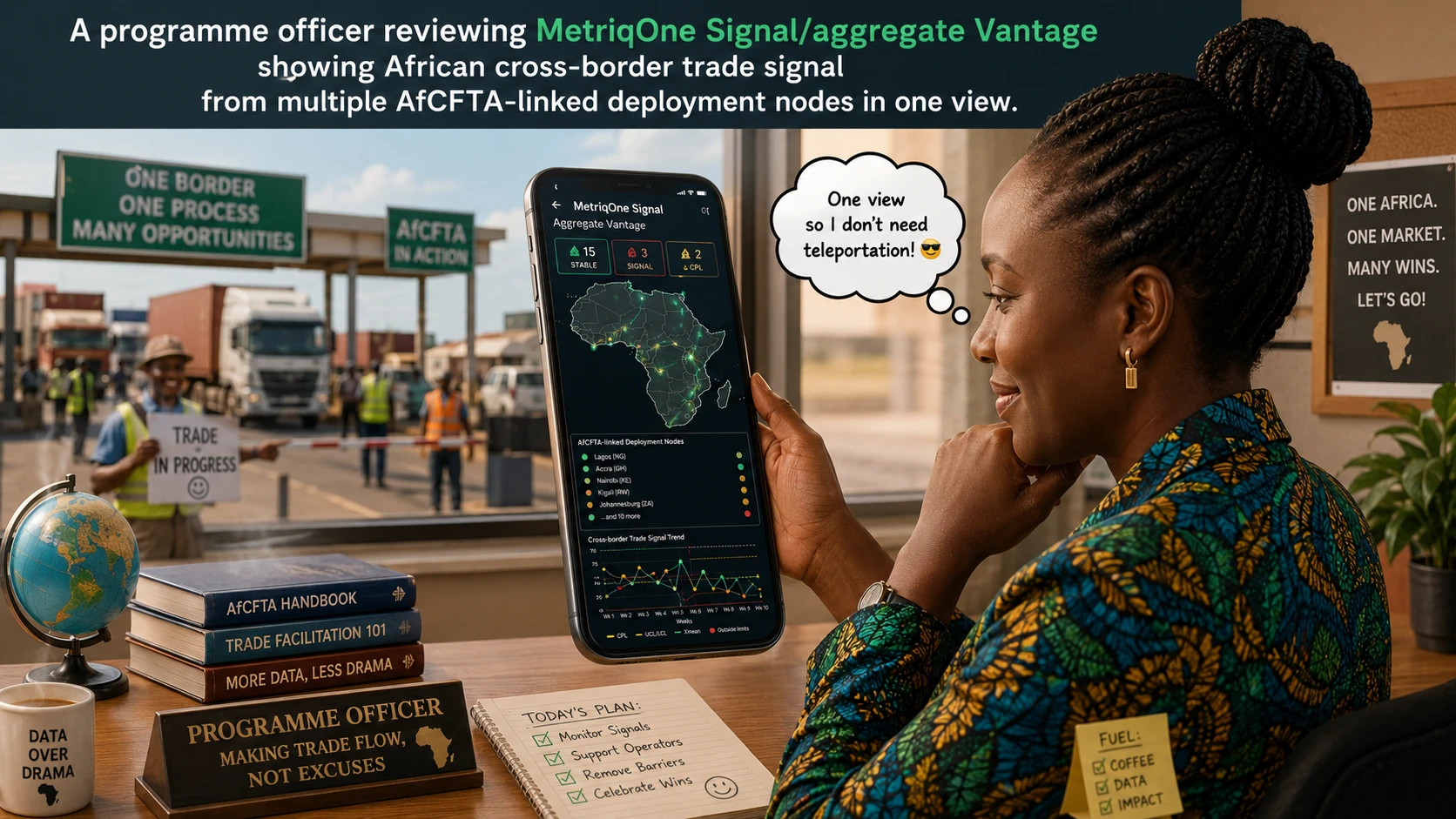
Aggregate Vantage does not ask member states to change how they report. It reads CRI convergence from Organisation and Cooperative tier nodes directly — the same measurement standard at every node, regardless of which member state it sits in — and shows a programme officer one evidence layer across every deployment simultaneously.
贸易雄心与贸易实际表现之间的差距
面向项目官员和基金经理
A disbursement or a trade-facilitation decision that touches three or four member states currently means reconciling three or four separate reporting formats, on three or four different cycles, each self-reported by the node itself. There is no single point where someone can see whether cross-border trade activity is actually stable, growing, or quietly failing — only a stack of annual claims that arrive too late to act on.
对于跨境贸易的中小微企业和合作社
The enterprises actually doing AfCFTA-linked trade are asked to produce proof of consistent, verifiable activity for financing, customs, or bulk-buyer negotiations — and most have nothing but a notebook and a bank statement to offer. The evidence a lender or a trade partner wants and the evidence the enterprise can actually produce are not the same thing.
Both sides are missing the same layer: a field-level evidence standard that is identical no matter which member state the node sits in, read in one place instead of reconciled after the fact.
Aggregate Vantage如何解读信号
Aggregate Vantage does not average data across countries or produce a single blended number. It reads each node's own CRI convergence and shows every node, named, in one evidence layer.
贸易证据的采集地点
Organisation and Cooperative tier nodes capture field-level activity — paper form and QR submission, offline-capable — the same standard whether the node is a solo trader or a cooperative, and regardless of which member state it operates in.
Aggregate Vantage跨节点读取数据
CRI convergence — confirmation from at least 2 of 3 signal modules — is read from every AfCFTA-linked node simultaneously. Each node's status stays visible on its own; nothing is blended into a single continental figure that hides which node is actually driving a result.
项目官员在何处履行职责
A programme officer monitoring trade activity across several nodes sees which specific node is outside its confirmed range — a name, not a colour on a blended chart — before an annual report would have surfaced it at all.
五个次区域,一条贸易走廊标准
AfCFTA-linked trade activity looks different in each sub-region — different goods, different corridor infrastructure, different dominant trade patterns. The evidence standard underneath stays identical everywhere; only the shape of what gets captured changes.
北非AMU
Established manufacturing and processing trade routes into Sub-Saharan corridors. The verification need here is consistency across a longer, more industrialised supply chain — CRI convergence at each handoff point rather than one enterprise-level reading.
西非ECOWAS
The highest concentration of AfCFTA-linked MSME and cooperative trade activity on the continent, much of it informal-economy adjacent. Cooperative tier registration — one TIN, one collective evidence chain — fits this shape directly.
中非ECCAS
Trade corridors here are the least continuous of any sub-region — nodes go quiet and resume as access and conditions change. Deactivation never deletes, so a node that pauses does not lose its evidence history when trade activity resumes.
东非EAC · IGAD
Two overlapping regional bodies and some of the most mature mobile-first field operations on the continent, which makes this sub-region the strongest fit for smartphone-based QR submission alongside paper-compatible fallback where connectivity is inconsistent.
南部非洲SADC
The most developed cross-border digital payment backbone of the five sub-regions — the natural proving ground for reading full CRI convergence across several nodes in near-real time, with the least infrastructure compensation required anywhere else.
为什么一种观点成立,而和解却不成立
无论节点位于哪个成员国,每个节点都遵循相同的证据标准——事后无需进行任何协调。
节点以名称单独显示,绝不会混合成一个大陆平均值,从而掩盖哪个节点才是真正驱动结果的因素。
CRI融合——3 个模块中有 2 个确认——是视图中每个节点的相同支付级标准。
在采集点优先采用离线方式和纸质兼容方式——证据链中不包含任何连接性假设。
一条贸易走廊,一层证据。
If your programme, fund, or trade-facilitation mandate touches more than one AfCFTA member state, the question is not whether cross-border trade is happening. It is whether you can see it — confirmed, node by node, before the annual report arrives.