
Measures Die at the Cradle
Think of the last time bad news reached you too late to fix cheaply. Not because anyone lied — the people closest to it saw it early, and clearly, and in time. It simply had to travel to reach you, and it did not survive the trip.
That distance is the whole subject. Not intelligence. Not effort. Distance.
Where the Chain Is Short, the Signal Lives
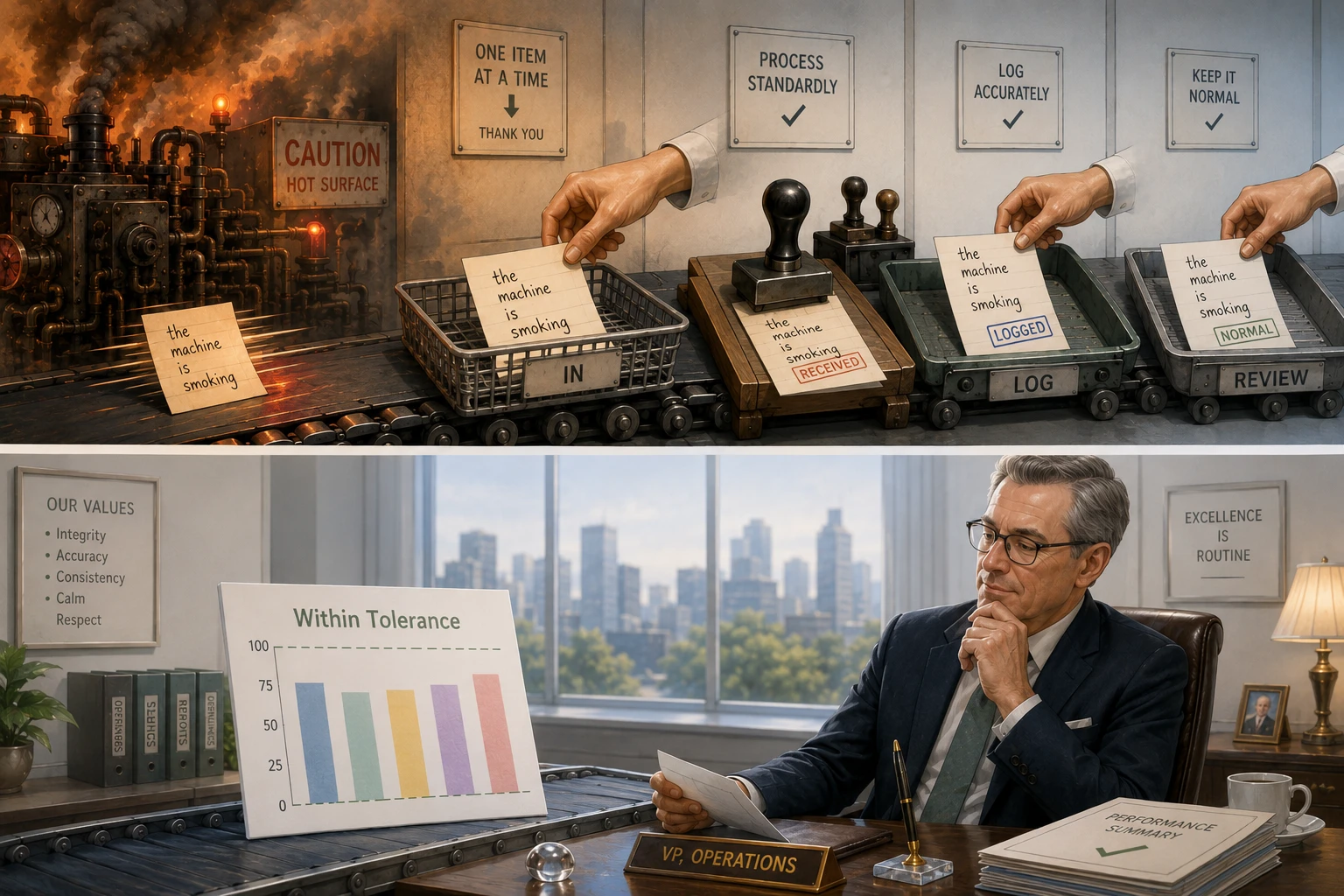
In a small operation, the person who sees the problem and the person who can act on it are the same person — or one conversation apart. Nobody files anything. Somebody says the machine is smoking, and somebody who can act is already turning around. Problem and response arrive together, because there is no room between them for the news to die.
You have felt this in your own smallest teams. The two-person project where everything was visible. You did not need a report. You needed to look up.
Where the Chain Is Long, the Signal Dies — by Design
Not by failure. Not by negligence. By design.
Your organisation was built in tiers. Strategy at the top, operations in the middle, execution on the floor — each with its own cycle, its own format, its own word for what counts as performance. Sensible. Also lethal to signal.
Between each tier: a handoff. Between each handoff: a translation. Between each translation: a loss.
So walk it in your own house. The person who sees it first. The one who logs it. The one who rolls it up. The one who formats it for the deck. The one who finally presents it to you. Five hands, five quiet softenings — each person certain they passed the signal on, each in fact passing their reading of it, trimmed for the room it was heading into.
What lands on your desk is the version that survived all five. Which is another way of saying the version nobody along the way found alarming enough to sharpen. The thing that most needed you was the thing most likely to be smoothed. The chain selects for comfort, not for truth.

You Are Not Slow — You Were Handed Something Already Asleep
Here is the part that is neither your fault nor theirs. A signal that has been summarised, averaged and pre-approved has nothing raw left to catch on. Nothing in it to wake you. You read it the way you drive the familiar road home: competent, unalarmed, remembering none of it afterwards.
The long chain does not lower anyone's intelligence. It manufactures autopilot — and then routes the one thing that mattered straight into the lane where attention runs thinnest.
You have sat in that meeting. The real thing never surfaced, and everyone in the room was awake enough to miss it.
The Bandages You Have Already Tried
Every organisation feels this, and reaches for the same shelf of cures. Look at yours honestly.
Its existence is the confession: if the ordinary chain carried signal, nobody would bolt a spare one to the wall. A note goes in, gets emptied, sorted, softened, handed up as a digest. A second chain, worse than the first.
A fine policy that everyone is too many corridors away to walk through. The distance it was meant to close is the distance that keeps them out.
A brighter dashboard, a heavier platform, an AI bolted on top. Each adds a screen. Not one removes the distance — and distance was the disease.
Does the fix hand the signal back to the person standing next to the evidence — or does it route the signal upward, to be synthesised for you?
Add a step, it is a bandage. Remove a step, it is a cure. A more powerful system at the top of a long chain does not repair the chain. It processes the output of a broken chain faster, and calls the speed insight.

What a Short Chain Looks Like
You do not need a transformation programme to picture it. One person. One thing they can actually see. One signal a day. A simple running average that shows the pattern without anyone needing to interpret it. A line that names the odd day without naming a culprit. A short note on what the day was like — the weather around the work, never the worker.
That chain hands you something you can act on. Not because it survived a long journey — because it never had to make one. You could start it this week. With a pen, if a pen is all you have.
Before You Fix Anything, Count
Here is the only homework. In your own operation, take one number you rely on, and count the hands between the person who first sees the reality and you. That count is your signal's survival odds. If it is more than one or two, you are not receiving the signal. You are receiving what the chain agreed to let through.
Then ask the question nobody enjoys: when did you last get bad news early enough to fix it cheaply?
If you cannot remember, the problem was never your judgement. It was the length of the chain that had to reach you. The signal is already there. It was always there. It just could not survive the distance.
A short chain deploys on paper, runs on a fixed rhythm, and asks nothing of the infrastructure around it that is not already there. It works in the smallest field office exactly as well as the largest head office.
See a Short Chain WorkingMetriqOne · Evidence without noise · metriq.one