
What Omission Actually Looks Like
A KPI stack built to confirm intent will, reliably, confirm intent — right up until the moment the gap between intent and reality is too large to paper over. It will produce green dashboards during a drift that has been running for months. It will submit on-time reports that summarise conditions that no longer exist. It will brief stakeholders with numbers that are accurate about the wrong things.
This is not fraud. It is architecture. A measurement system that was designed to track whether strategic targets are being reported against will do exactly that, and nothing more. It will not tell you whether the field reality underlying those reports matches the strategic intent the targets were built on. That is not what it was built to do.
The word for what such a system produces is not inaccuracy. The word is omission.

The Gap That Omission Creates
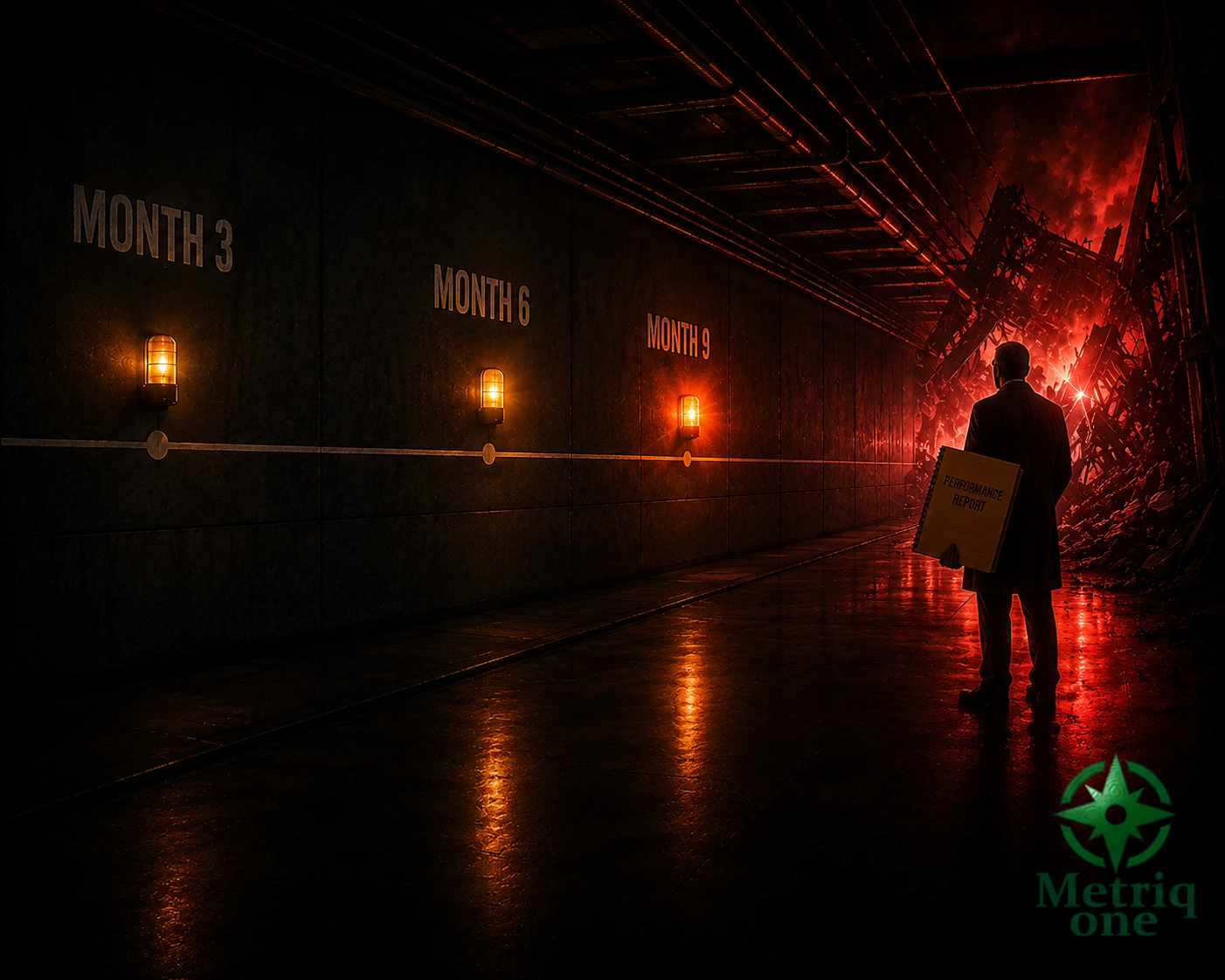
Consider what actually happens between the point where an organisation commits to a strategic objective and the point where it reports against it. The commitment is made at a level of abstraction — a target, a percentage, a by-when. The delivery happens at a level of operational detail — individual field activities, daily decisions, resource constraints that were not visible at the planning stage. Between commitment and reporting, a chain of hand-offs, summaries, and interpretations condenses what happened in the field into a number that fits the target's format.
At each hand-off in that chain, the signal gets thinner. Field-level nuance becomes a local summary. Local summaries become a departmental report. Departmental reports become a dashboard figure. The dashboard figure gets compared to the target and flagged green or red. By the time the figure reaches a decision-maker, the operational reality that produced it may bear very little relationship to what the target was measuring.
This is not corruption, and it is not negligence. It is the structural consequence of a measurement chain that was designed to produce reportable numbers rather than to detect drift between what was intended and what is actually happening.

What Gets Omitted
The specific things that fall out of a standard KPI stack are consistent enough to be named.
Rate of change, not just current position. A metric that is still inside its target range but moving steadily toward the boundary will show green right up until it shows red. A signal architecture catches the trajectory; a reporting system catches only the snapshot.
The gap between reported activity and verified output. A team that submits on-time reports is not the same as a team whose on-the-ground activity matches what those reports describe. Without a field-level verification layer, the reporting chain has no mechanism to distinguish between the two.
Early drift in processes that produce late-appearing results. Structural failures, supply-chain degradations, and programme-delivery gaps all tend to have long lead times between early warning and visible outcome. A measurement system calibrated to outcomes will always arrive late. A measurement system calibrated to process signals can arrive early enough to act.
These are not exotic failure modes. They are the standard failure modes of organisations that have sophisticated reporting infrastructure and no signal architecture underneath it.
The Architecture That Closes It
The distinction between a reporting system and a signal architecture is not a matter of more data or better software. It is a matter of what the measurement system was designed to detect.
A reporting system detects whether targets have been met, reported, and filed. It is designed to produce a record of intent-versus-outcome at regular intervals. A signal architecture detects drift — the moment a process begins moving away from its committed trajectory, before the drift has become large enough to appear in any target comparison. It is designed to produce an early warning, not a record.
The structural requirement for a signal architecture is simple and demanding at the same time: every committed process needs a baseline, a Natural Process Limit, and a pre-signal threshold. Without all three, the measurement system cannot distinguish between noise and a signal. It produces numbers. It does not produce signals.
Most KPI stacks omit all three by design — not maliciously, but because they were built to confirm reporting, and confirmation does not require a baseline, a limit, or a threshold. It only requires a target and a number.
There is a harder version of this problem, and it belongs here. In organisations that have operated long enough, the gap between the report and the ground is no longer a surprise. It is an expectation. People who have been around for more than one reporting cycle have learned, from experience, that the report will say one thing and the field will show another. They have accommodated that gap — worked around it, factored it into their informal judgement, built their own shadow systems to compensate. The official measurement architecture keeps producing its reports. Everyone knows not to take them at face value. And nobody escalates, because the gap has become normal.
This is the condition that is harder to fix than ignorance. An organisation that does not know its measurement system is blind can be shown what it is missing. An organisation that knows, has always known, and has simply learned to live with it — that organisation has a cultural accommodation to undo before it has an architecture problem to solve. The report is not believed. But it is still produced, still filed, still cited. And the gap it papers over keeps widening, on a timeline nobody is officially watching.
The omission is structural. Closing it requires an architecture built for a different purpose.
MetriqOne · Evidence without noise · metriq.one