
Why KPI Stacks Are Structurally Designed to Miss It
The literature on performance measurement has a problem it has never fully resolved, and the problem is not a lack of frameworks. Since Drucker's (1954) foundational proposition that organisations require a balanced set of performance measures, the field has expanded across accounting, operations management, psychology, and public governance — and in every direction it has expanded, it has produced more frameworks, more indicators, and more sophisticated reporting architectures. What it has not consistently produced is a mechanism for detecting drift between what an organisation intended and what it is actually delivering.
This is not an oversight. It is a structural consequence of what performance measurement frameworks were built to do.

The Chain-Length Problem
Bititci et al. (1997) identified what they called the alignment gap — the consistent finding that strategic intent does not reliably translate into field-level activity. The further the field is from the strategic decision, the more the signal degrades. A target set at headquarters becomes a departmental objective, which becomes a team task, which becomes an individual's daily work — and at each translation, something is lost. By the time a field reading makes its way back up the same chain as a reported figure, the original strategic intent and the operational reality are often describing different things in the same language.
Garengo (2005) put a sharper point on the same observation in the context of small and medium enterprises: in settings where the service chain is long, important measures die at the cradle. The measurement architecture does not survive the journey from strategic intent to field reality and back. What gets reported is whatever the chain can carry — which is not the same as whatever the field is actually producing.
This is a structural problem, not a people problem. It does not get better by hiring more diligent reporters, installing more sophisticated dashboards, or increasing the frequency of reviews.
It gets better only when the measurement architecture is redesigned to operate at the point where the signal is actually generated — the field — rather than at the point where reports are collected.

The Missing Conditions
Falsifiability Condition Four — the absence of formalised Natural Process Limits in a performance measurement framework — is the specific structural gap that allows drift to remain invisible until it becomes undeniable (Skogvold, 2026). Wheeler and Chambers (1992), building on Shewhart's (1931) original distinction between common-cause and special-cause variation, demonstrated that a measurement reading without a process limit attached to it is not a signal. It is a number. The number may be accurate as a point-in-time observation and still tell an observer nothing about whether the process producing it is in control, drifting, or already broken.
The Balanced Scorecard, OKRs, and LogFrame-based monitoring systems were not built to close this gap. They were built to track progress against targets — which is a different task. Tracking progress against a target tells an organisation whether it is on course at the point of measurement. It does not tell an organisation whether the course itself has already changed, or whether the measurement it is relying on is capturing the thing it was meant to capture rather than a summary of a summary of the thing.
The result is a consistent pattern across every sector and every governance system that relies on standard KPI architectures: the gap between strategic intent and field reality widens quietly, measurement by measurement, report by report, until it is too large to paper over — at which point it becomes visible all at once, usually in the form of a crisis, an investigation, or a downgrade.
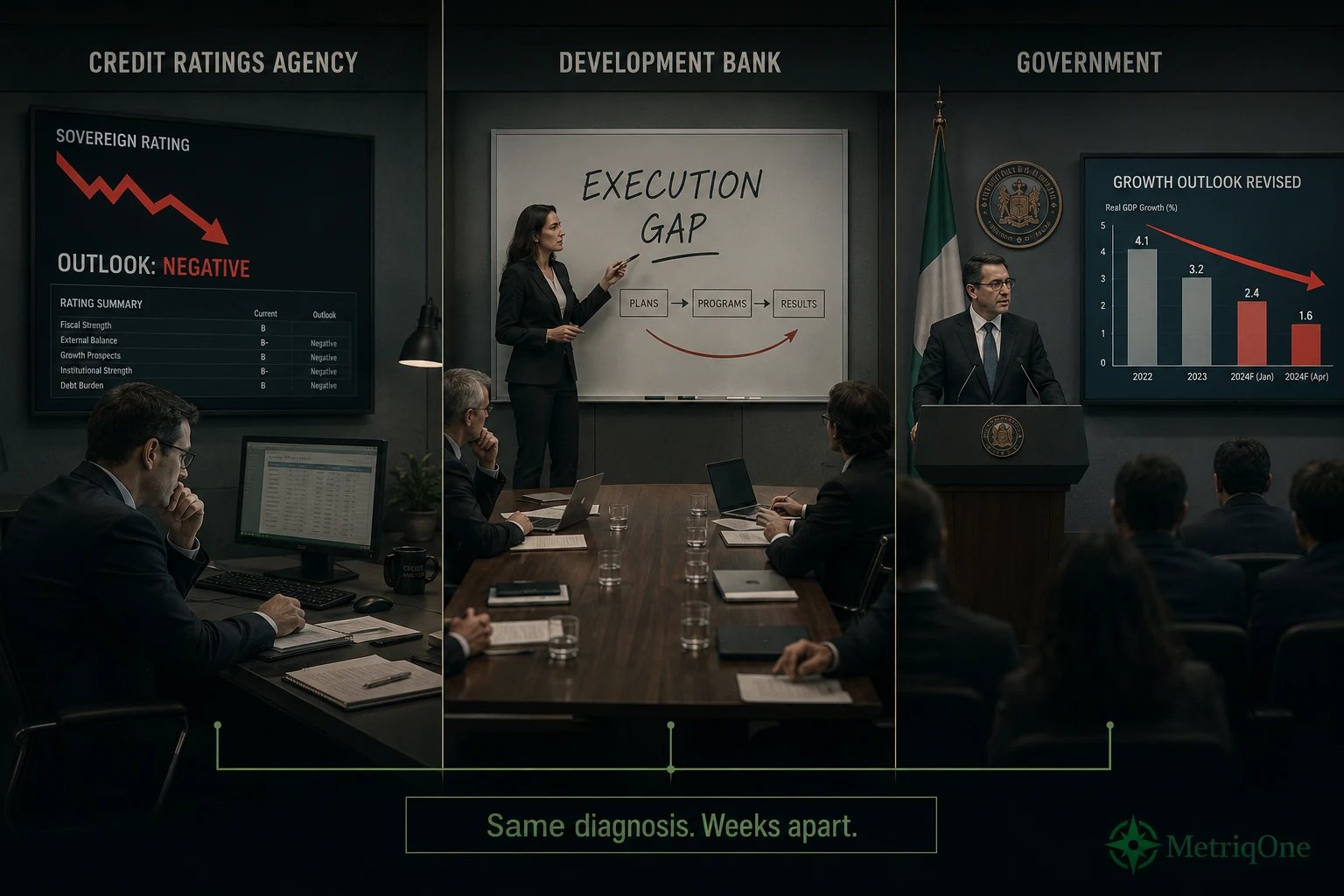
The Same Week, Three Institutions
In the third quarter of 2026 alone, three independent institutions arrived at the same diagnosis by three different routes. A major credit ratings agency downgraded a Southeast Asian banking sector's outlook, naming an unresolved infrastructure probe — a gap between what was reported and what was verified on the ground. A continental development finance institution stated publicly that the infrastructure crisis it was tracking was not a funding gap but an execution gap. A global financial data provider reported a national government cutting its own growth forecast, citing a corruption crackdown as a cause — a crackdown whose existence confirmed that the reporting chain had not detected the drift in time to prevent it.
Three institutions. Three mandates. The same finding: the measurement architecture in place was designed to confirm, not to detect.
It confirmed, faithfully, right up until the gap became undeniable.
What Would Have Caught It Earlier
A baseline. A Natural Process Limit. A pre-signal threshold — set voluntarily, at the point of commitment, by the party making the commitment, at a level below where the statistical limit would fire. Three structural additions to any performance commitment that would convert it from a reporting instrument into a signal instrument.
None of these require new technology. None require a budget approval. They require an agreement, made at the point of commitment, about what evidence at what level would constitute a genuine warning — rather than a post-facto investigation into what went wrong after the warning window had already closed.
Most KPI stacks omit all three. Not by accident. By design. They were built for a different purpose, and they perform that purpose reliably. The question is whether confirmation is the purpose an organisation actually needs — or whether it can afford to find out the difference only after it is too late.
Bititci, U.S. et al. (1997). Integrated Performance Measurement Systems.
Drucker, P.F. (1954). The Practice of Management.
Garengo, P. (2005). Performance measurement systems in SMEs.
Shewhart, W.A. (1931). Economic Control of Quality of Manufactured Product.
Skogvold, T. (2026). Foundations of Evidence-Based Leadership.
Wheeler, D.J. and Chambers, D.S. (1992). Understanding Statistical Process Control.
MetriqOne · Evidence without noise · metriq.one