Agenda 2063 — Vérification sans délai de transmission des informations
Africa's 50-year blueprint runs on a biennial reporting cycle that aggregates upward through eight Regional Economic Communities into one Continental Results Framework. The blueprint is sound. The signal that feeds it is not — most of what reaches the continental level is self-reported, lagging, and unverifiable at the point of claim.
MetriqOne does not propose a new framework to sit alongside Agenda 2063. It proposes a way to verify the one that already exists — evidence captured where the work actually happens, paper-compatible, and structurally incapable of surveillance.
L'écart entre le plan et les preuves
Pour les institutions continentales
The Continental Results Framework depends on Member States and RECs submitting progress data on a fixed cycle. Every layer of that chain currently relies on self-report. By the time a number reaches a continental report, no one upstream can say with confidence what evidence it was built on — only that it arrived on schedule.
Pour les responsables de programmes
NGOs, cooperatives, and implementing partners on the ground are asked to prove delivery against indicators set two or three layers above them — usually with a connectivity assumption that does not hold where the programme is actually running. The result is a reporting burden that competes directly with delivery time, and donors who receive narrative where they need evidence.
Both problems are the same problem: the evidence chain breaks at the point furthest from power and closest to the work. MetriqOne is built to hold at exactly that point.
Comment les cartes architecturales
MetriqOne's stacked — Designation Bridge, CSI, Module, PI, CRI — does not require a continental redesign to attach to Agenda 2063 reporting. It sits underneath it, as the evidence layer the existing framework currently lacks.
Là où naissent les preuves
Programme Indicators (PIs) are captured at agent level — the cooperative, the field office, the single delivery point — observable and paper-compatible, with no connectivity assumption.
Lorsque les preuves sont agrégées
Modules and Critical Result Indicators (CRIs) roll evidence upward without discarding the chain — a regional body sees a verified result, not a re-typed claim.
Quand les données probantes rencontrent la gouvernance
The Designation Bridge keeps every CRI traceable back to the aspiration it was meant to serve — so a continental report can show its working, not just its conclusion.
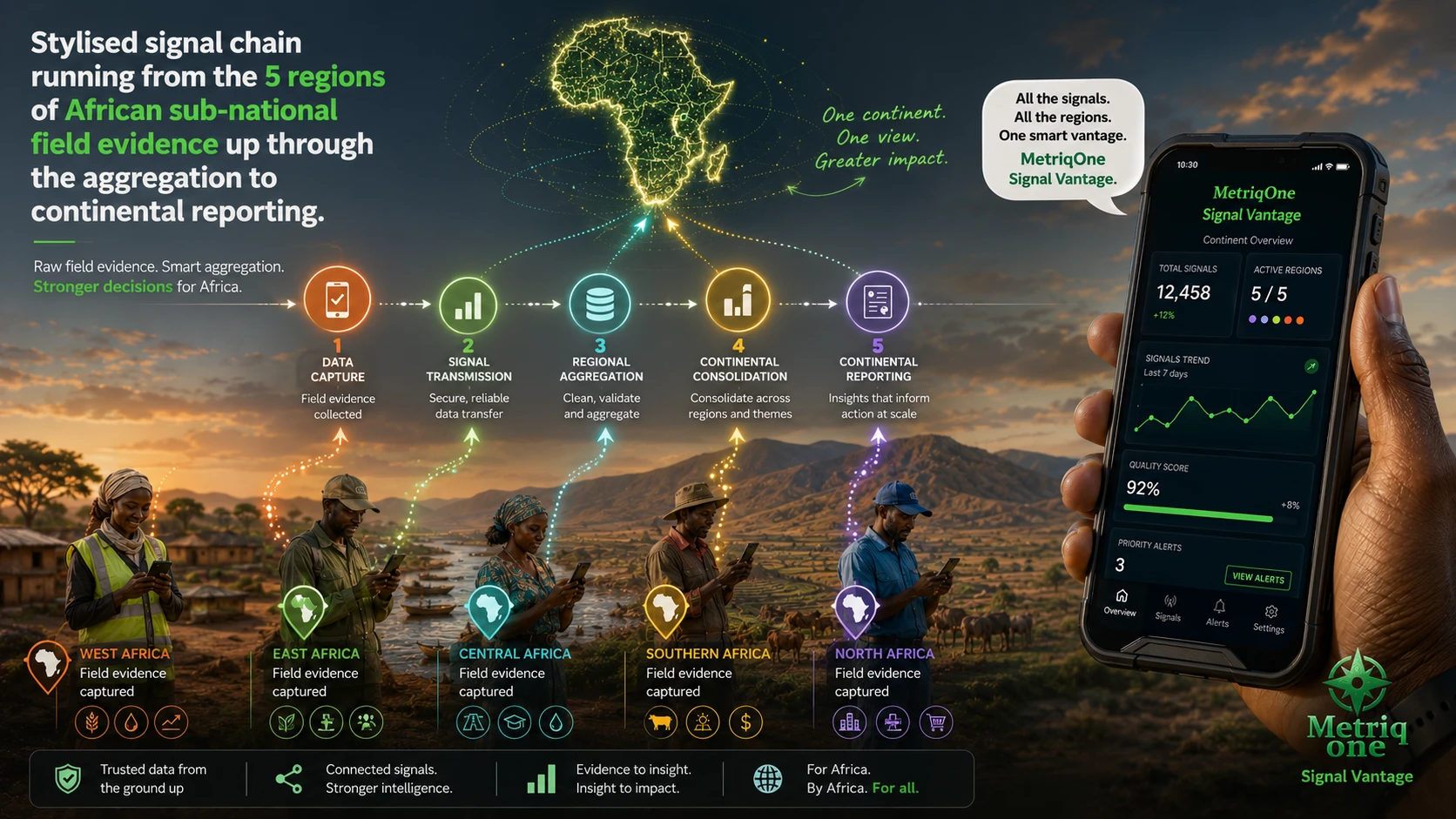
Cinq sous-régions, un problème de vérification, cinq formes différentes
Agenda 2063 delivery runs through Regional Economic Communities, but the verification problem looks different in each sub-region. The architecture underneath stays the same — what changes is which parts carry the weight.
Afrique du NordAMU
Institutional capacity is comparatively strong, but cross-border programme data still arrives at the regional level shaped by each Member State's own reporting convention. The verification gap here is not infrastructure — it is comparability. A CRI defined once at the Module level and carried unchanged through the stack closes that gap without asking any institution to change its own internal process.
Afrique de l'OuestECOWAS
The highest density of cooperatives, MSMEs, and informal-economy programme delivery on the continent — and the widest gap between where programmes run and where digital payment infrastructure reaches. The Node Business model exists for exactly this shape: a physical operator handling onboarding and evidence capture for delivery points that have no digital rail of their own, without surveilling them to get it.
Afrique centraleECCAS
Reporting infrastructure is the thinnest here of any sub-region, and programme presence is often discontinuous — agents move in and out of coverage as access and funding allow. The Agent Register handles this natively: deactivation never deletes, so a programme that pauses for six months does not lose its evidence chain when it resumes.
Afrique de l'EstEAC · IGAD
Two overlapping regional bodies, frequent climate and security shocks, and some of the most mature mobile-first field operations on the continent. This is the sub-region where early warning matters most — CPL thresholds are set below where XmR fires, so a coordinator sees a stable-but-below-floor condition weeks before a statistically confirmed breach, not after a shock has already disrupted delivery.
Afrique australeSADC
The most developed digital payment and connectivity backbone of the five sub-regions, which makes it the natural proving ground for the full two-layer architecture — agent-level evidence feeding a management spine that feeds the regional governance loop, with the least infrastructure compensation required anywhere else.
Pourquoi cela se vérifie là où l'auto-déclaration ne se vérifie pas
Conçu avant tout pour une utilisation hors ligne et compatible avec le format papier — aucune hypothèse de connectivité n'est intégrée à la chaîne de preuves.
Aucune visibilité des données au-delà de ce que chaque couche est désignée pour voir — l'absence de capacité de surveillance est structurelle, et non politique.
La désactivation n'efface jamais les données — la chaîne de preuves survit aux interruptions, aux déficits de financement et au roulement du personnel.
Chaque Critical Result Indicator reste traçable jusqu'à l'aspiration qu'il sert, grâce au Designation Bridge .
Est-ce important ? — Mesurez-le !
If your programme reports into Agenda 2063 — directly or through a REC, a Member State, or a donor who does — the question is not whether the blueprint is sound. It is whether anyone can verify, at the point of claim, that the evidence behind it is real.