Pour les petites entreprises
Votre entreprise suit une logique. La plupart des propriétaires ne s'en rendent jamais compte.
A good week and a bad week feel the same in the moment — you just keep working. Without a record, you can't tell the difference between normal ups and downs and something actually going wrong, until it's already a problem. MetriqOne's whole purpose is showing you that difference early enough to do something about it.
That is the main thing it does: read your own numbers back to you in a way that catches drift while it's still small, so you can find the real cause and fix it — before a bad month becomes a bad year. A printed, dated record of how your business performs comes along with that, almost as a side effect — and it happens to be exactly what a bank or a buyer wants to see. Here is what actually happens, week by week.

Trois entreprises. Un même point de départ.
Des travaux différents, le même problème : impossible de distinguer une variation normale d’un véritable signal d’alarme, et aucun document écrit auquel une banque ou un acheteur pourrait se fier. Nous suivrons ces trois éléments jusqu’à ce que le déroulement des événements se produise.

Le Marchand
Il achète et vend des marchandises sur un marché ou à la frontière. Il effectue des transactions chaque semaine. Rien n'est inscrit sur les documents.

Le fermier
Cultive et vend ses produits selon un cycle fixe. Le rendement est variable. On ne dispose d'aucune trace de ce à quoi ressemble un rendement « normal ».

L'atelier
Fabrique ou répare des objets sur commande. Assure des livraisons fiables. N'a jamais eu à le prouver à personne — jusqu'à présent.
Ce qui se passe réellement — semaine après semaine
Vous vous inscrivez — et vous décidez ce que signifie « amende ».
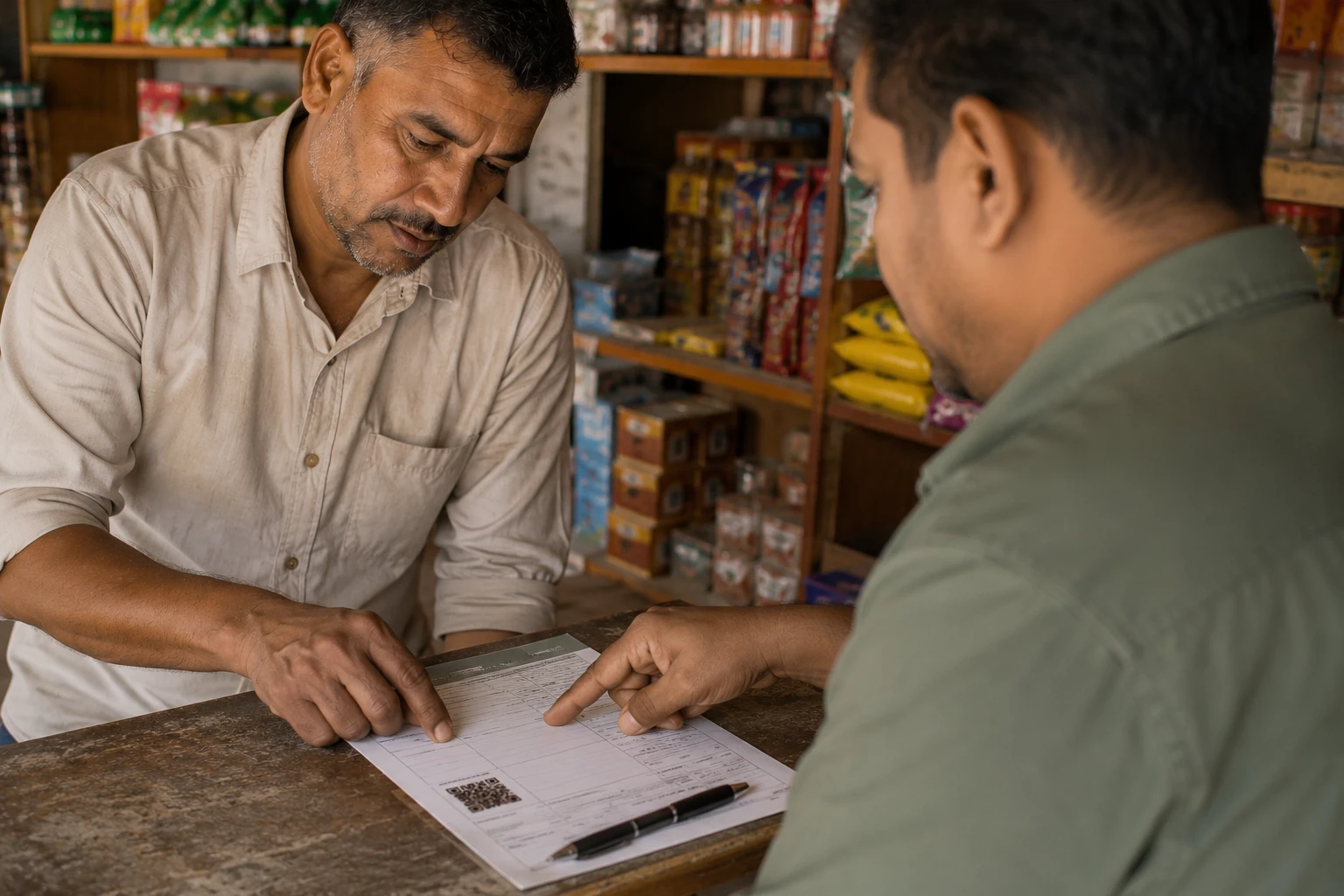
You register once, either yourself with a smartphone, or through a local print shop or cooperative office that does it for you on paper — this is called a Node-Business, and it exists specifically for people without a smartphone or reliable internet. Either way, you become a Member Operator on your own account, called a Field account: it belongs to you, not to anyone above you.
You answer a few honest questions about your business — what it actually is, what's working against it right now, what "doing fine" looks like in your own terms. You also set one number — a threshold you choose — below which you want to know something's wrong. This is called your CPL. No one sets it for you. You know your business; the number is yours.
Vous soumettez ce que vous faites déjà
Once a week — or however often makes sense for your business — you record a few real numbers from your own work. On the app if you have one. On paper, submitted through your Node-Business, if you don't. No new work. Just writing down what you already know.
Vous voyez votre propre schéma pour la première fois

After a few weeks of readings, enough data exists to calculate your natural range — called XmR — the pattern your own numbers actually follow, worked out from your own history, not a guess. This is the moment the framework starts doing its real job: telling the difference between a normal bad week and a genuine warning sign.
From this point on, you have two things watching for you at once: the threshold you chose on Day 1, and the pattern your own business just revealed about itself. And because the readings are already there, you can also print a proof report right now — a record showing consistent, in-limit performance, ready the moment a bank or a buyer asks for it.
À titre indicatif seulement — vos propres lectures hebdomadaires, vos propres limites, calculées à partir de votre propre historique.
C'est là que cela vous aide réellement à aller mieux
Here is what that looks like in practice. Take the Farmer from earlier. For months, weekly yield readings sit comfortably inside the natural range XmR calculated back in Month 1 — some weeks a little higher, some lower, all normal variation. Then, over three weeks, readings start drifting down. Not dramatically. Not yet below the CPL threshold. But the shape doesn't look like the usual up-and-down anymore — it looks like a trend.
That shape is the whole point. A single bad week means nothing on its own. A trend means something changed. Instead of finding out three months later when the season's income is visibly down, the Farmer sees it in week three and asks the right question early: what changed around here? Looking back, the irrigation schedule shifted after a pump was replaced two weeks before the drift started. Not a guess — a specific, dated, checkable cause, found because the timing lined up with the farmer's own readings, not with memory.
The irrigation timing gets adjusted back. The next few weeks' readings are the test: if the cause was right, yield recovers into the normal range again. It does. That recovery is confirmed by the exact same signal that caught the problem — not a hope that the fix worked, a checked one.
That loop — catch it early, find the real cause, fix it, confirm the fix worked — is what MetriqOne is actually for. The record this builds along the way never disappears either: nothing is deleted or overwritten, and if you pause for a season, everything is waiting exactly as you left it. A year from now, that record also happens to be exactly what a bank or a buyer wants to see. But that was never the main event — getting better at what you do, one caught problem at a time, is.
Ce que vous accomplissez réellement
On repère les problèmes lorsqu'ils sont encore petits.
Votre propre seuil et votre propre plage naturelle, tous deux vigilants – des semaines d’avertissement au lieu d’une surprise, comme l’agriculteur a perçu la dérive des rendements mentionnée plus haut.
Vous découvrez la véritable cause, et non une simple supposition.
Un signal indique le moment où les choses ont changé. En comparant ce signal aux événements qui se sont réellement produits à cette période, on transforme un simple dysfonctionnement en une cause précise et corrigeable.
Une banque regarde un historique, pas une promesse.
Une demande de prêt appuyée par un historique écrit de performances constantes et conformes aux limites fixées – et non un relevé de revenus auto-établi.
Un acheteur voit des preuves, pas un argumentaire.
Un contrat d'approvisionnement ou une commande permanente appuyée par des preuves que vous livrez de manière fiable, selon vos propres conditions.
Vous en êtes le propriétaire exclusif
Aucun siège social n'a accès à vos données, sauf si vous choisissez de les partager. Votre compte, votre signal, votre preuve imprimée.
Pas de smartphone ? Pas de problème.
Node-Business — une boutique que vous connaissez déjà
An existing print shop, cooperative office, or market desk — somewhere you already trust — registers you, prints your forms, submits them for you, and prints your proof report whenever you need it. Paper in, proof out. No app, no data plan, no new habit to learn.
Comment fonctionnent les entreprises Node ? →Vous faites déjà le travail. Commencez à discerner la régularité.
Nothing about your business needs to change. What changes is whether you can catch the moment something drifts, understand why, and fix it — before it costs you a season. Proof for a bank or a buyer comes along with that, but it was never the point. Getting better at what you already do is. That starts with a Day 1.
Commencer