
What Closes the Gap
The previous two pieces in this series have named the problem precisely: most KPI stacks are structurally designed to confirm intent rather than detect drift, and the gap they leave — between strategic intent and field reality — is not visible until it is already large. The question this piece answers is simpler than the problem: what closes it?
Not more data. Not a better dashboard. Not a more frequent reporting cycle. The gap is structural, and structural gaps close only when the architecture changes.

The Three Missing Conditions
A measurement system capable of detecting drift rather than merely confirming outcomes requires three structural additions to whatever reporting architecture is already in place. None of them are expensive. None require new technology. All of them require a decision made at the point of commitment rather than at the point of crisis.
The first is a baseline. Every committed process needs a starting point — a reading, taken at the moment the commitment is made, that establishes where the process actually is before any target-chasing begins. A baseline is not a target. It is a reading. The distinction matters: a target describes where an organisation wants to go; a baseline describes where it currently is. Without a baseline, every subsequent reading is a data point floating in space. With a baseline, every subsequent reading is a measurement of movement — and movement is what drift actually is.
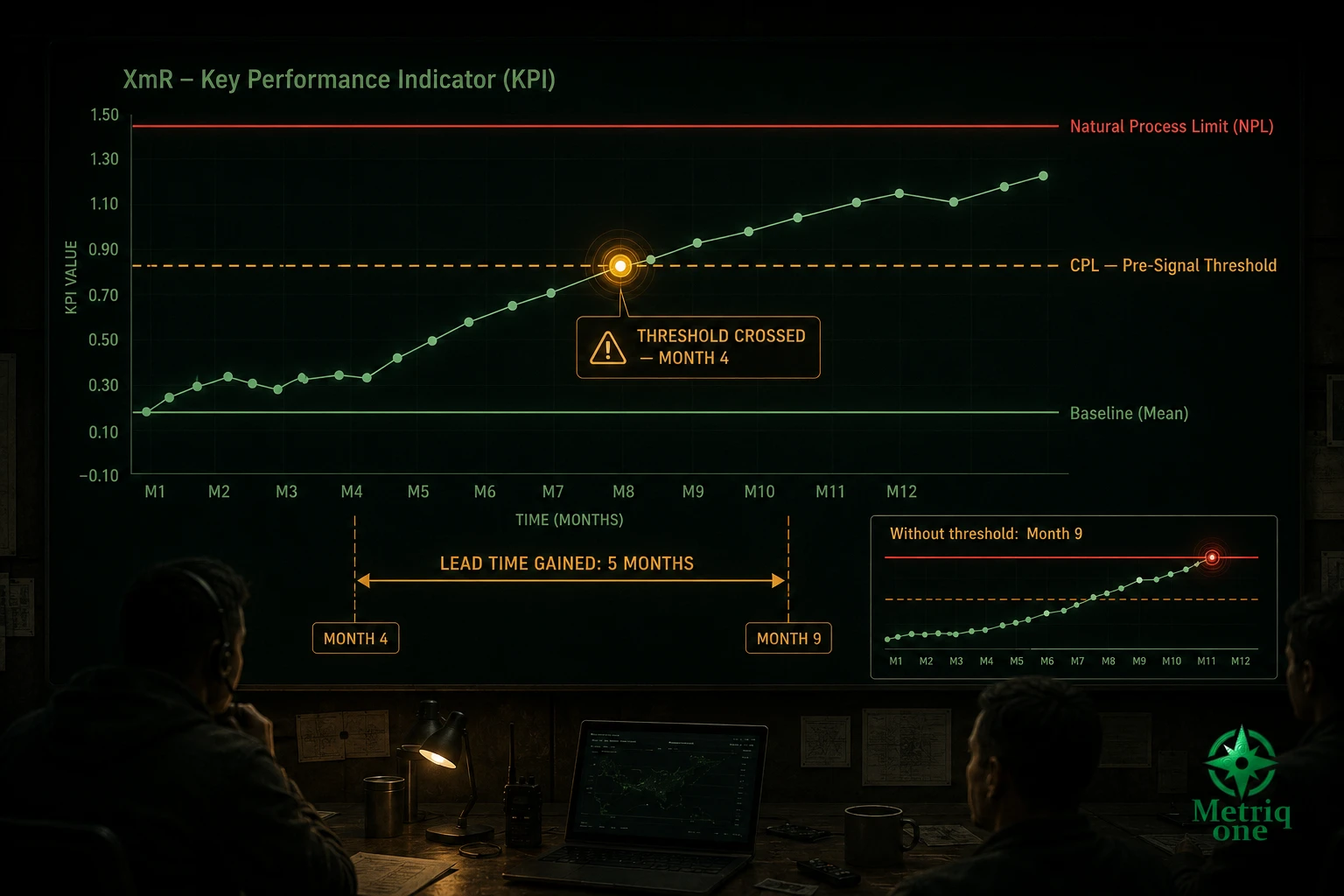
The second is a Natural Process Limit. Drawn from Wheeler and Shewhart's statistical process control methodology, a Natural Process Limit defines the boundary between normal variation and a genuine signal worth acting on. Any reading inside the limit is noise — the expected variation of a process in control. Any reading outside the limit is a signal — evidence that something has changed in the underlying process, not just in the surface measurement. Without a Natural Process Limit, an organisation cannot distinguish between a bad day and a bad trend.
The third is a pre-signal threshold. Set voluntarily, at the point of commitment, by the party making the commitment — at a level below the Natural Process Limit — the pre-signal threshold is the earliest warning layer. It fires before the statistical limit is breached, before the signal becomes unambiguous, before the intervention window has closed.
It is the structural guarantee that an organisation will be warned while there is still time to act, rather than confirmed in its failure after the fact.
Why the Order Matters
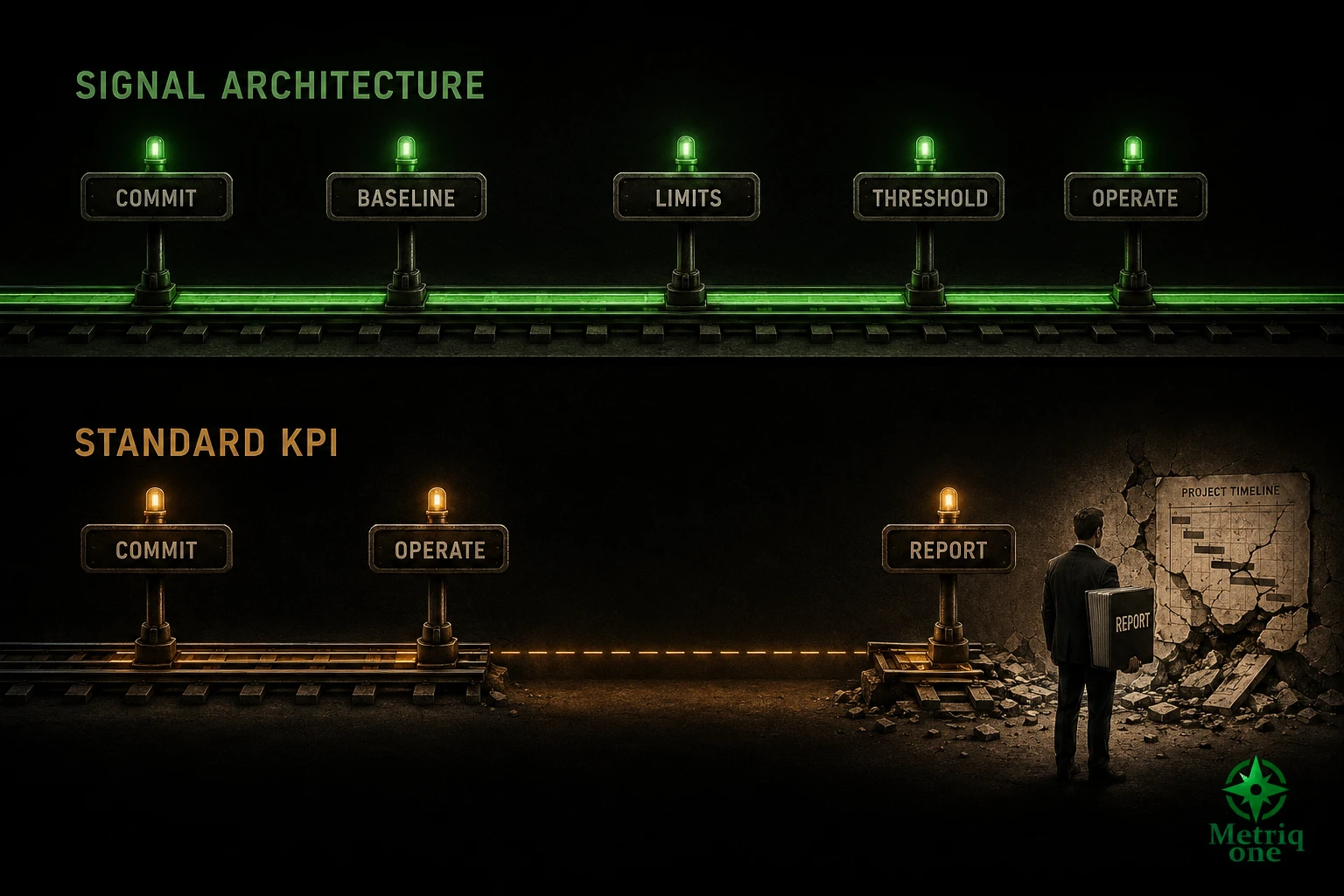
These three conditions are not interchangeable, and they do not work in any order other than the one stated. A baseline must come first, because without it neither a process limit nor a threshold can be correctly calibrated. A process limit must come second, because without it the threshold has no statistical foundation. The threshold must come last, because it is the thing that actually produces an early warning, and it can only do that job correctly if both the baseline and the limit are already in place.
The sequence is: commit, establish baseline, set limits, set threshold, operate. The standard KPI sequence is: commit, operate, report. The difference between the two sequences is the difference between a system designed to detect drift and a system designed to confirm completion.
What This Looks Like in Practice
In a cooperative, the pre-signal threshold is a manually configured level — set by the coordinator, at whatever collection frequency the operation requires, not imposed from outside — below which a collective reading triggers an early alert. It fires well before a statistical limit would be breached, at a point where the cause is still findable and the correction is still affordable.
In a bilateral infrastructure agreement, the same structure would convert a diplomatic commitment — currently unfalsifiable by design — into a claim about the world that can be confirmed, qualified, or denied by reference to observable data collected continuously at the field level.
In a government infrastructure programme, the pre-signal threshold would have caught, months before any investigation, the point at which construction-progress readings began drifting below the trajectory implied by the original commitment. Not as an accusation. As information — the kind of information that turns a future crisis into a present correction.
The Honest Limitation
These three conditions close the architecture gap. They do not close the will gap. An organisation that does not want to be caught drifting will not voluntarily set a pre-signal threshold — because a threshold is, among other things, the earliest available mechanism for making drift visible before it has its alibi ready.
What it can be solved by is exactly the kind of external pressure that three independent institutions applied in the same quarter this year — a credit downgrade, a development bank's public statement, a government's own growth-forecast cut. When the cost of not having a signal architecture becomes visible enough, the will tends to follow.
The gap has a name. The architecture that closes it exists. The only remaining question is which organisation decides to use it before the next report confirms what the signal already knew.
The three missing conditions — baseline, Natural Process Limit, pre-signal threshold — are not aspirational features. They are operational, deployed, and running today across cooperative, public-sector, NGO, and micro-enterprise contexts in low-connectivity environments where the reporting chain has always been too long and the signal has always arrived too late.
See the Architecture WorkingMetriqOne · Evidence without noise · metriq.one