Para pequenas empresas
Seu negócio tem um padrão. A maioria dos proprietários nunca consegue enxergá-lo.
A good week and a bad week feel the same in the moment — you just keep working. Without a record, you can't tell the difference between normal ups and downs and something actually going wrong, until it's already a problem. MetriqOne's whole purpose is showing you that difference early enough to do something about it.
That is the main thing it does: read your own numbers back to you in a way that catches drift while it's still small, so you can find the real cause and fix it — before a bad month becomes a bad year. A printed, dated record of how your business performs comes along with that, almost as a side effect — and it happens to be exactly what a bank or a buyer wants to see. Here is what actually happens, week by week.

Três empresas. Mesmo ponto de partida.
Trabalhos diferentes, mesma lacuna: não há como distinguir uma variação normal de um sinal de alerta real, e nada documentado em que um banco ou comprador possa confiar. Acompanharemos os três casos para ver o que realmente acontece.

O Comerciante
Compra e vende mercadorias em mercados ou além-fronteiras. Negocia semanalmente. Nada está documentado.

O Fazendeiro
Cultiva e vende produtos agrícolas em um ciclo fixo. A produção varia. Não há registro de como seria o período "normal".

A Oficina
Fabrica ou conserta coisas sob encomenda. Entrega com confiabilidade. Nunca precisou provar isso a ninguém — até agora.
O que realmente acontece — semana a semana
Você se cadastra — e você decide o que significa "multa".
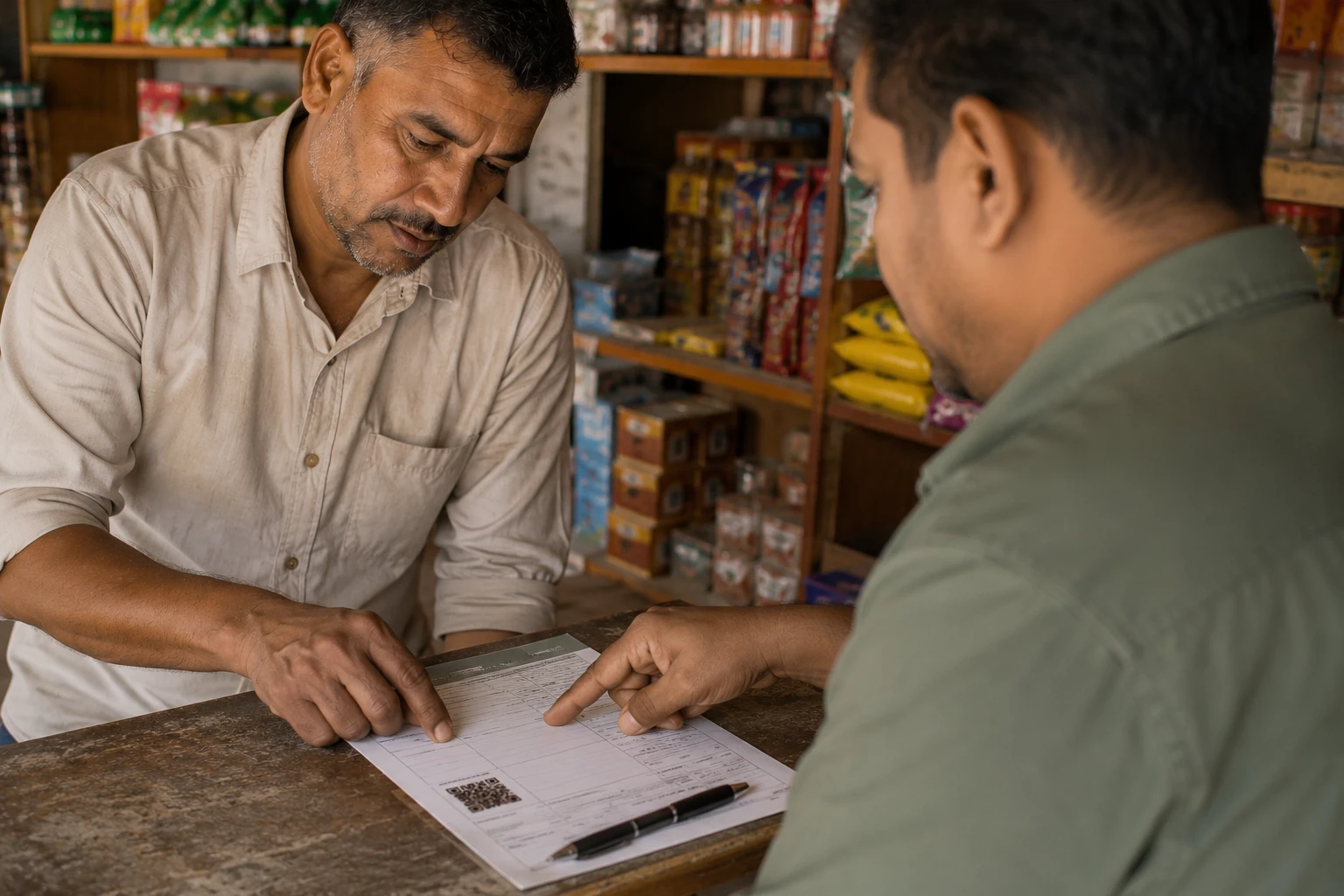
You register once, either yourself with a smartphone, or through a local print shop or cooperative office that does it for you on paper — this is called a Node-Business, and it exists specifically for people without a smartphone or reliable internet. Either way, you become a Member Operator on your own account, called a Field account: it belongs to you, not to anyone above you.
You answer a few honest questions about your business — what it actually is, what's working against it right now, what "doing fine" looks like in your own terms. You also set one number — a threshold you choose — below which you want to know something's wrong. This is called your CPL. No one sets it for you. You know your business; the number is yours.
Você envia o que já está fazendo.
Once a week — or however often makes sense for your business — you record a few real numbers from your own work. On the app if you have one. On paper, submitted through your Node-Business, if you don't. No new work. Just writing down what you already know.
Você vê seu próprio padrão pela primeira vez.

After a few weeks of readings, enough data exists to calculate your natural range — called XmR — the pattern your own numbers actually follow, worked out from your own history, not a guess. This is the moment the framework starts doing its real job: telling the difference between a normal bad week and a genuine warning sign.
From this point on, you have two things watching for you at once: the threshold you chose on Day 1, and the pattern your own business just revealed about itself. And because the readings are already there, you can also print a proof report right now — a record showing consistent, in-limit performance, ready the moment a bank or a buyer asks for it.
Apenas para fins ilustrativos — suas próprias leituras semanais, suas próprias linhas limite, calculadas a partir do seu próprio histórico.
É aqui que realmente te ajuda a melhorar.
Here is what that looks like in practice. Take the Farmer from earlier. For months, weekly yield readings sit comfortably inside the natural range XmR calculated back in Month 1 — some weeks a little higher, some lower, all normal variation. Then, over three weeks, readings start drifting down. Not dramatically. Not yet below the CPL threshold. But the shape doesn't look like the usual up-and-down anymore — it looks like a trend.
That shape is the whole point. A single bad week means nothing on its own. A trend means something changed. Instead of finding out three months later when the season's income is visibly down, the Farmer sees it in week three and asks the right question early: what changed around here? Looking back, the irrigation schedule shifted after a pump was replaced two weeks before the drift started. Not a guess — a specific, dated, checkable cause, found because the timing lined up with the farmer's own readings, not with memory.
The irrigation timing gets adjusted back. The next few weeks' readings are the test: if the cause was right, yield recovers into the normal range again. It does. That recovery is confirmed by the exact same signal that caught the problem — not a hope that the fix worked, a checked one.
That loop — catch it early, find the real cause, fix it, confirm the fix worked — is what MetriqOne is actually for. The record this builds along the way never disappears either: nothing is deleted or overwritten, and if you pause for a season, everything is waiting exactly as you left it. A year from now, that record also happens to be exactly what a bank or a buyer wants to see. But that was never the main event — getting better at what you do, one caught problem at a time, is.
O que você realmente conquista
Você detecta os problemas enquanto eles ainda são pequenos.
Seu próprio limite e sua própria faixa natural, ambos observando ao mesmo tempo — semanas de aviso em vez de uma surpresa, da mesma forma que o fazendeiro percebeu a deriva da produção acima.
Você descobre a verdadeira causa, não um palpite.
Um sinal indica quando as coisas mudaram. Comparar esse sinal com o que realmente aconteceu naquela época transforma a sensação de que "algo está errado" em uma causa específica e solucionável.
Um banco avalia o histórico, não uma promessa.
Um pedido de empréstimo respaldado por um histórico impresso de desempenho consistente e dentro dos limites — não uma declaração de renda escrita pelo próprio solicitante.
Um comprador vê provas, não uma apresentação.
Um contrato de fornecimento ou pedido permanente respaldado por evidências de que você realiza entregas de forma confiável, conforme suas próprias condições.
Você é dono de cada pedacinho disso.
Nenhuma sede lê seus dados, a menos que você opte por compartilhá-los. Sua conta, seu sinal, seu comprovante impresso.
Sem smartphone? Sem problema.
Node-Business — uma loja que você já conhece.
An existing print shop, cooperative office, or market desk — somewhere you already trust — registers you, prints your forms, submits them for you, and prints your proof report whenever you need it. Paper in, proof out. No app, no data plan, no new habit to learn.
Como funcionam os negócios Node →Você já faz o trabalho. Comece a perceber o padrão.
Nothing about your business needs to change. What changes is whether you can catch the moment something drifts, understand why, and fix it — before it costs you a season. Proof for a bank or a buyer comes along with that, but it was never the point. Getting better at what you already do is. That starts with a Day 1.
Comece agora