Per le piccole imprese
La tua attività segue uno schema. La maggior parte dei titolari non riesce mai a vederlo.
A good week and a bad week feel the same in the moment — you just keep working. Without a record, you can't tell the difference between normal ups and downs and something actually going wrong, until it's already a problem. MetriqOne's whole purpose is showing you that difference early enough to do something about it.
That is the main thing it does: read your own numbers back to you in a way that catches drift while it's still small, so you can find the real cause and fix it — before a bad month becomes a bad year. A printed, dated record of how your business performs comes along with that, almost as a side effect — and it happens to be exactly what a bank or a buyer wants to see. Here is what actually happens, week by week.

Tre aziende. Stesso punto di partenza.
Lavoro diverso, stesso divario: impossibile distinguere una normale variazione da un vero segnale di allarme, e niente di scritto di cui una banca o un acquirente si fiderebbero. Seguiremo tutti e tre fino a che punto si trovano realmente.

Il commerciante
Compra e vende merci al mercato o oltre confine. Effettua scambi ogni settimana. Non c'è nulla di scritto in tal senso.

Il contadino
Coltiva e vende prodotti secondo un ciclo prestabilito. La resa è variabile. Non esiste un registro di come dovrebbe essere una resa "normale".

L'officina
Realizza o ripara oggetti su ordinazione. Consegna in modo affidabile. Non ha mai dovuto dimostrarlo a nessuno, fino ad ora.
Cosa succede realmente, settimana per settimana
Ti registri e decidi tu cosa significa "multa".
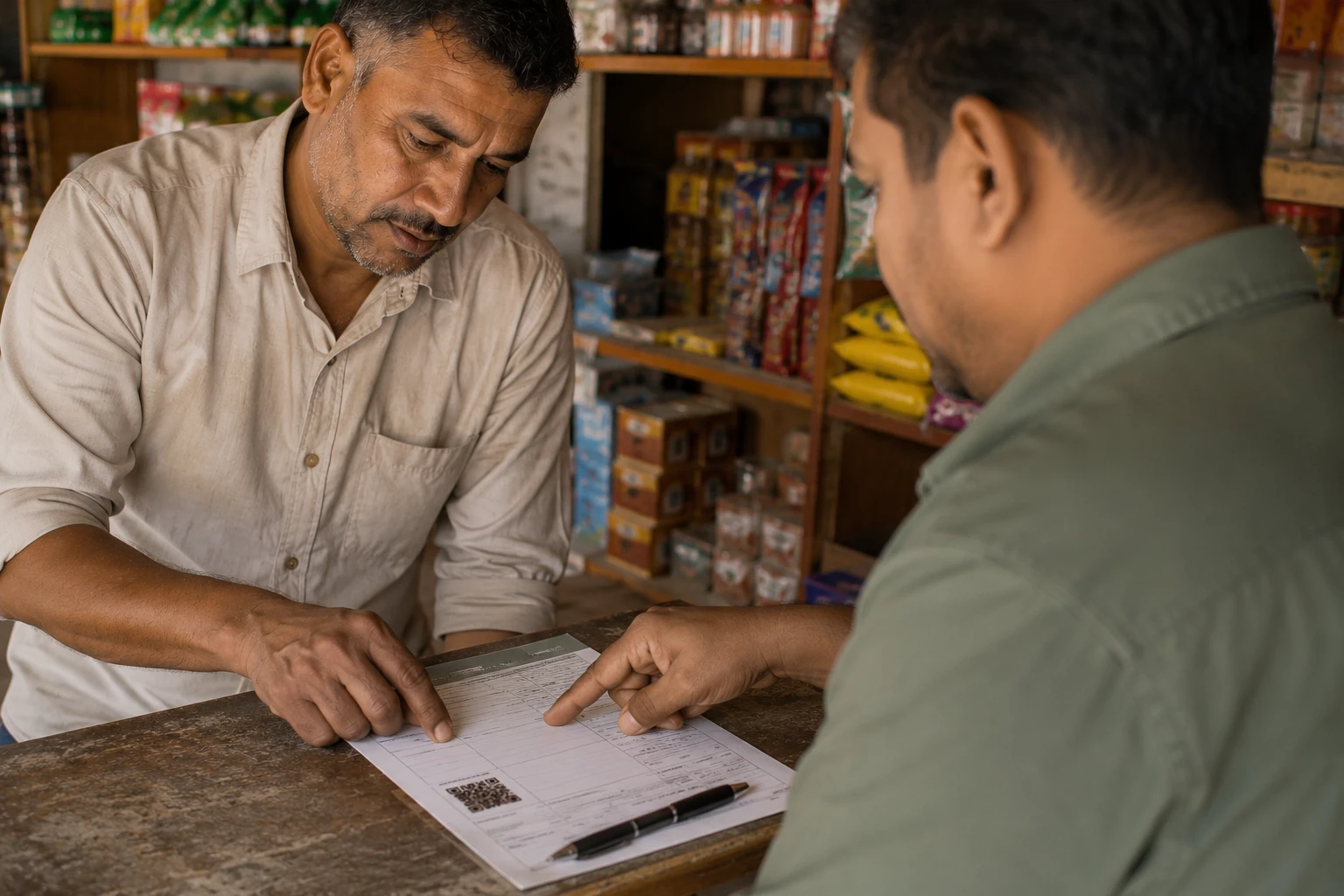
You register once, either yourself with a smartphone, or through a local print shop or cooperative office that does it for you on paper — this is called a Node-Business, and it exists specifically for people without a smartphone or reliable internet. Either way, you become a Member Operator on your own account, called a Field account: it belongs to you, not to anyone above you.
You answer a few honest questions about your business — what it actually is, what's working against it right now, what "doing fine" looks like in your own terms. You also set one number — a threshold you choose — below which you want to know something's wrong. This is called your CPL. No one sets it for you. You know your business; the number is yours.
Invii ciò che stai già facendo
Once a week — or however often makes sense for your business — you record a few real numbers from your own work. On the app if you have one. On paper, submitted through your Node-Business, if you don't. No new work. Just writing down what you already know.
Vedi il tuo schema per la prima volta

After a few weeks of readings, enough data exists to calculate your natural range — called XmR — the pattern your own numbers actually follow, worked out from your own history, not a guess. This is the moment the framework starts doing its real job: telling the difference between a normal bad week and a genuine warning sign.
From this point on, you have two things watching for you at once: the threshold you chose on Day 1, and the pattern your own business just revealed about itself. And because the readings are already there, you can also print a proof report right now — a record showing consistent, in-limit performance, ready the moment a bank or a buyer asks for it.
Solo a scopo illustrativo: le tue letture settimanali, i tuoi limiti, calcolati in base alla tua storia personale.
È qui che ti aiuta davvero a migliorare
Here is what that looks like in practice. Take the Farmer from earlier. For months, weekly yield readings sit comfortably inside the natural range XmR calculated back in Month 1 — some weeks a little higher, some lower, all normal variation. Then, over three weeks, readings start drifting down. Not dramatically. Not yet below the CPL threshold. But the shape doesn't look like the usual up-and-down anymore — it looks like a trend.
That shape is the whole point. A single bad week means nothing on its own. A trend means something changed. Instead of finding out three months later when the season's income is visibly down, the Farmer sees it in week three and asks the right question early: what changed around here? Looking back, the irrigation schedule shifted after a pump was replaced two weeks before the drift started. Not a guess — a specific, dated, checkable cause, found because the timing lined up with the farmer's own readings, not with memory.
The irrigation timing gets adjusted back. The next few weeks' readings are the test: if the cause was right, yield recovers into the normal range again. It does. That recovery is confirmed by the exact same signal that caught the problem — not a hope that the fix worked, a checked one.
That loop — catch it early, find the real cause, fix it, confirm the fix worked — is what MetriqOne is actually for. The record this builds along the way never disappears either: nothing is deleted or overwritten, and if you pause for a season, everything is waiting exactly as you left it. A year from now, that record also happens to be exactly what a bank or a buyer wants to see. But that was never the main event — getting better at what you do, one caught problem at a time, is.
Ciò che effettivamente si ottiene
Si individuano i problemi quando sono ancora piccoli
La tua soglia e il tuo range naturale osservano entrambi contemporaneamente: settimane di preavviso invece di una sorpresa, proprio come l'agricoltore ha colto la deriva della resa menzionata sopra.
Si individua la vera causa, non si fa un'ipotesi.
Un segnale indica il momento in cui le cose sono cambiate. Confrontando questo segnale con ciò che è effettivamente accaduto in quel periodo, si trasforma un "qualcosa non va" in una causa specifica e risolvibile.
Una banca guarda alla storia, non alle promesse.
Una richiesta di prestito supportata da uno storico documentato di pagamenti costanti e entro i limiti previsti, non da una dichiarazione dei redditi redatta autonomamente.
Un acquirente vede le prove, non una presentazione
Un contratto di fornitura o un ordine permanente supportato da prove che attestino la vostra affidabilità nelle consegne, secondo le vostre condizioni.
Ne possiedi ogni singolo pezzo
Nessuna sede centrale legge i tuoi dati a meno che tu non scelga di condividerli. Il tuo account, il tuo segnale, la tua prova stampata.
Niente smartphone? Nessun problema.
Node-Business : un negozio che già conosci
An existing print shop, cooperative office, or market desk — somewhere you already trust — registers you, prints your forms, submits them for you, and prints your proof report whenever you need it. Paper in, proof out. No app, no data plan, no new habit to learn.
Come funzionano le aziende Node. →Il lavoro lo fai già. Inizia a notare lo schema.
Nothing about your business needs to change. What changes is whether you can catch the moment something drifts, understand why, and fix it — before it costs you a season. Proof for a bank or a buyer comes along with that, but it was never the point. Getting better at what you already do is. That starts with a Day 1.
Inizia