適用於小型企業
你的企業是有規律可循的,但大多數企業主從未發現過。
A good week and a bad week feel the same in the moment — you just keep working. Without a record, you can't tell the difference between normal ups and downs and something actually going wrong, until it's already a problem. MetriqOne's whole purpose is showing you that difference early enough to do something about it.
That is the main thing it does: read your own numbers back to you in a way that catches drift while it's still small, so you can find the real cause and fix it — before a bad month becomes a bad year. A printed, dated record of how your business performs comes along with that, almost as a side effect — and it happens to be exactly what a bank or a buyer wants to see. Here is what actually happens, week by week.

三家企業,相同的起點。
不同的工作,同樣的差距:無法區分正常波動和真正的預警信號,也沒有任何書面記錄能讓銀行或買家信服。我們將追蹤這三起事件的進展。

交易員
在市集或跨境買賣貨物。每週都進行交易。但沒有任何書面記錄。

農夫
按固定週期種植和銷售農產品。產量不穩定。甚至沒有記錄顯示「正常」產量是什麼樣子。

研討會
按訂單製作或維修物品。送貨可靠。以前從未需要向任何人證明這一點——直到現在。
實際發生的情況-每週更新
您自行註冊—並自行決定「罰款」的含義
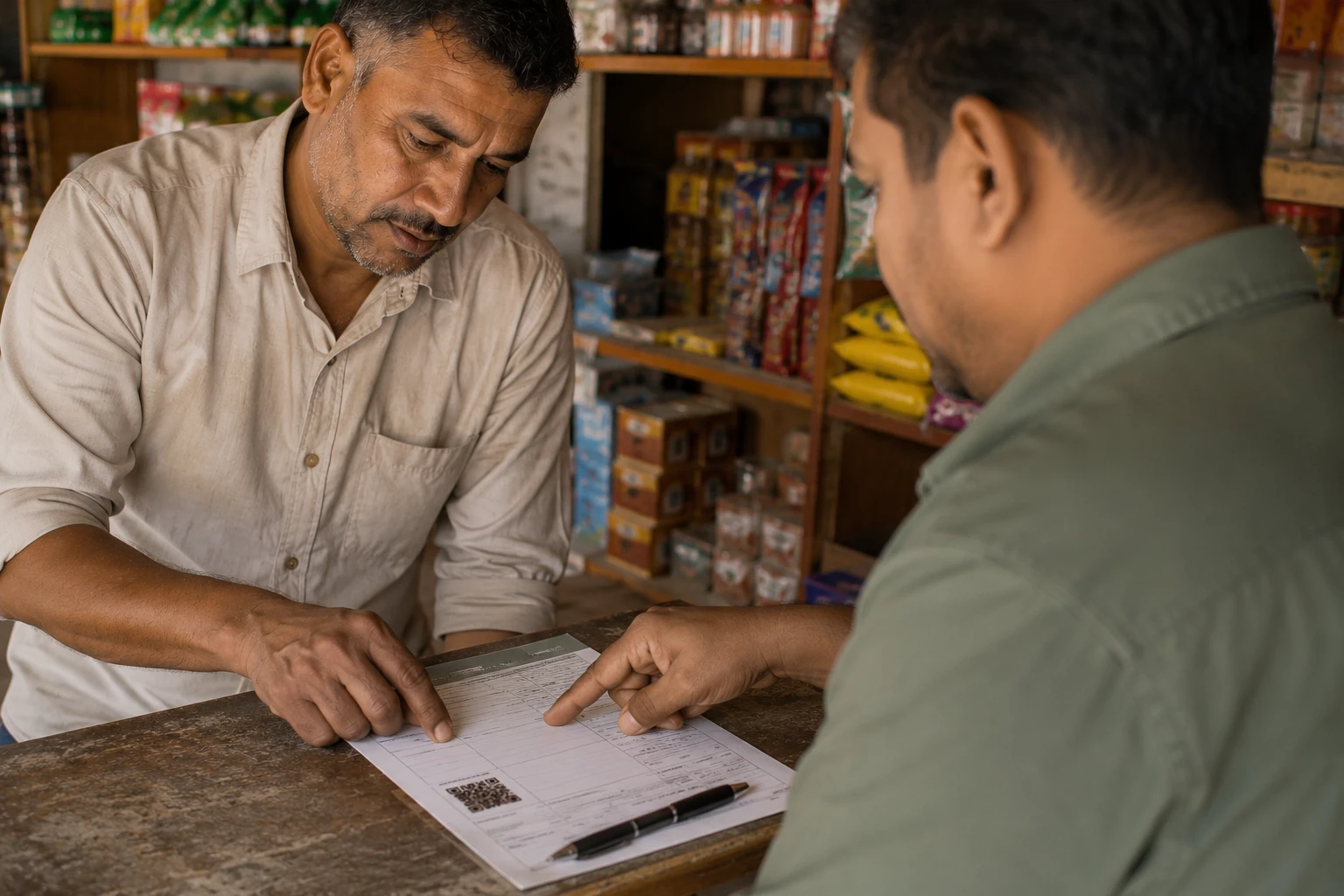
You register once, either yourself with a smartphone, or through a local print shop or cooperative office that does it for you on paper — this is called a Node-Business, and it exists specifically for people without a smartphone or reliable internet. Either way, you become a Member Operator on your own account, called a Field account: it belongs to you, not to anyone above you.
You answer a few honest questions about your business — what it actually is, what's working against it right now, what "doing fine" looks like in your own terms. You also set one number — a threshold you choose — below which you want to know something's wrong. This is called your CPL. No one sets it for you. You know your business; the number is yours.
你提交的是目前正在做的事情
Once a week — or however often makes sense for your business — you record a few real numbers from your own work. On the app if you have one. On paper, submitted through your Node-Business, if you don't. No new work. Just writing down what you already know.
你第一次看清了自己的模式

After a few weeks of readings, enough data exists to calculate your natural range — called XmR — the pattern your own numbers actually follow, worked out from your own history, not a guess. This is the moment the framework starts doing its real job: telling the difference between a normal bad week and a genuine warning sign.
From this point on, you have two things watching for you at once: the threshold you chose on Day 1, and the pattern your own business just revealed about itself. And because the readings are already there, you can also print a proof report right now — a record showing consistent, in-limit performance, ready the moment a bank or a buyer asks for it.
僅供參考—您自己的每週讀數、您自己的限制線,根據您自己的歷史記錄計算。
這就是它真正幫助你進步的地方。
Here is what that looks like in practice. Take the Farmer from earlier. For months, weekly yield readings sit comfortably inside the natural range XmR calculated back in Month 1 — some weeks a little higher, some lower, all normal variation. Then, over three weeks, readings start drifting down. Not dramatically. Not yet below the CPL threshold. But the shape doesn't look like the usual up-and-down anymore — it looks like a trend.
That shape is the whole point. A single bad week means nothing on its own. A trend means something changed. Instead of finding out three months later when the season's income is visibly down, the Farmer sees it in week three and asks the right question early: what changed around here? Looking back, the irrigation schedule shifted after a pump was replaced two weeks before the drift started. Not a guess — a specific, dated, checkable cause, found because the timing lined up with the farmer's own readings, not with memory.
The irrigation timing gets adjusted back. The next few weeks' readings are the test: if the cause was right, yield recovers into the normal range again. It does. That recovery is confirmed by the exact same signal that caught the problem — not a hope that the fix worked, a checked one.
That loop — catch it early, find the real cause, fix it, confirm the fix worked — is what MetriqOne is actually for. The record this builds along the way never disappears either: nothing is deleted or overwritten, and if you pause for a season, everything is waiting exactly as you left it. A year from now, that record also happens to be exactly what a bank or a buyer wants to see. But that was never the main event — getting better at what you do, one caught problem at a time, is.
你實際取得的成就
趁問題還小的時候就發現它們。
你自身的閾值和自身的自然範圍同時在觀察——幾週的預警而不是意外,就像農夫注意到上面的產量波動一樣。
你要找到真正的原因,而不是靠猜測。你要找到的是真正的原因,而不是猜測。
信號表明事情何時發生了變化。將該訊號與當時實際發生的事情進行比對,就能將「出了點問題」轉化為具體、可解決的原因。
銀行看重的是過往業績,而不是承諾。
貸款申請需提供書面證明,證明貸款人績效始終在貸款限額內,而非僅提供一份自行撰寫的收入報表。
買家看到的是證據,而不是推銷話術。
一份有證據支持的供貨合約或長期訂單,證明您能夠按照自己的條件可靠地交付貨物。
它完全屬於你。
除非您選擇分享,否則總部不會讀取您的資料。您的帳戶、您的訊號、您的列印稿。
沒有智慧型手機?沒問題。
Node-Business您早已熟知的商店
An existing print shop, cooperative office, or market desk — somewhere you already trust — registers you, prints your forms, submits them for you, and prints your proof report whenever you need it. Paper in, proof out. No app, no data plan, no new habit to learn.
節點業務的運作方式 →你已經做了這些工作。開始發現其中的規律吧。
Nothing about your business needs to change. What changes is whether you can catch the moment something drifts, understand why, and fix it — before it costs you a season. Proof for a bank or a buyer comes along with that, but it was never the point. Getting better at what you already do is. That starts with a Day 1.
開始使用