Voor kleine bedrijven
Uw bedrijf volgt een patroon. De meeste eigenaren zien dit patroon nooit.
A good week and a bad week feel the same in the moment — you just keep working. Without a record, you can't tell the difference between normal ups and downs and something actually going wrong, until it's already a problem. MetriqOne's whole purpose is showing you that difference early enough to do something about it.
That is the main thing it does: read your own numbers back to you in a way that catches drift while it's still small, so you can find the real cause and fix it — before a bad month becomes a bad year. A printed, dated record of how your business performs comes along with that, almost as a side effect — and it happens to be exactly what a bank or a buyer wants to see. Here is what actually happens, week by week.

Drie bedrijven. Hetzelfde uitgangspunt.
Verschillende benaderingen, dezelfde kloof: geen manier om normale variatie te onderscheiden van een echt waarschuwingssignaal, en niets op schrift dat een bank of koper zou vertrouwen. We volgen alle drie de scenario's tot het daadwerkelijke verloop.

De handelaar
Koopt en verkoopt goederen op een markt of over de grens. Handelt wekelijks. Staat nergens op papier.

De boer
De gewassen worden volgens een vast schema geteeld en verkocht. De opbrengst varieert. Er is geen registratie van hoe een "normale" oogst eruitziet.

De Workshop
Maakt of repareert dingen op bestelling. Levert betrouwbaar. Heeft het nog nooit aan iemand hoeven bewijzen — tot nu toe.
Wat er daadwerkelijk gebeurt — Week na week
U registreert zich en u bepaalt wat "boete" inhoudt.
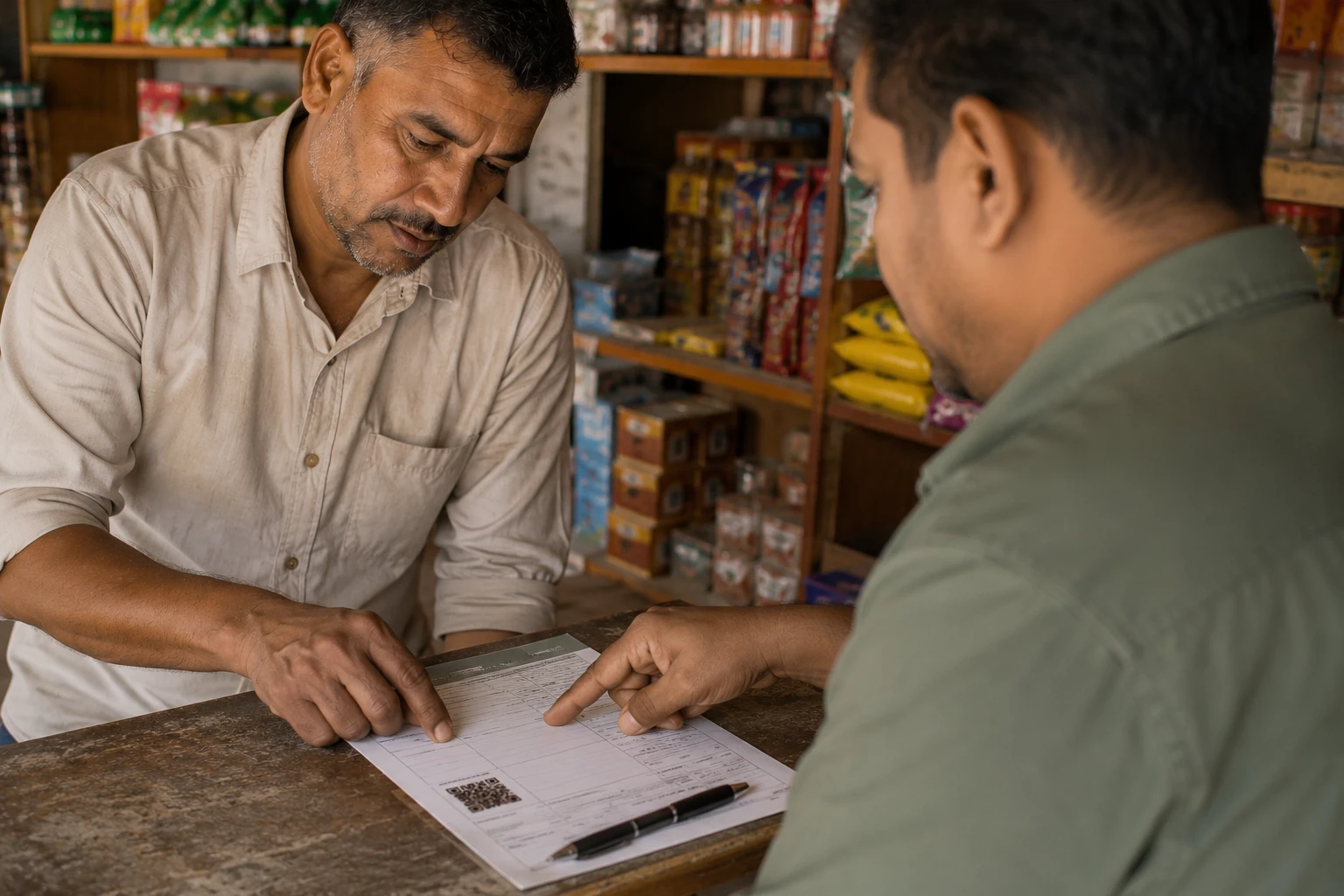
You register once, either yourself with a smartphone, or through a local print shop or cooperative office that does it for you on paper — this is called a Node-Business, and it exists specifically for people without a smartphone or reliable internet. Either way, you become a Member Operator on your own account, called a Field account: it belongs to you, not to anyone above you.
You answer a few honest questions about your business — what it actually is, what's working against it right now, what "doing fine" looks like in your own terms. You also set one number — a threshold you choose — below which you want to know something's wrong. This is called your CPL. No one sets it for you. You know your business; the number is yours.
Je dient in wat je al doet.
Once a week — or however often makes sense for your business — you record a few real numbers from your own work. On the app if you have one. On paper, submitted through your Node-Business, if you don't. No new work. Just writing down what you already know.
Je ziet voor het eerst je eigen patroon.
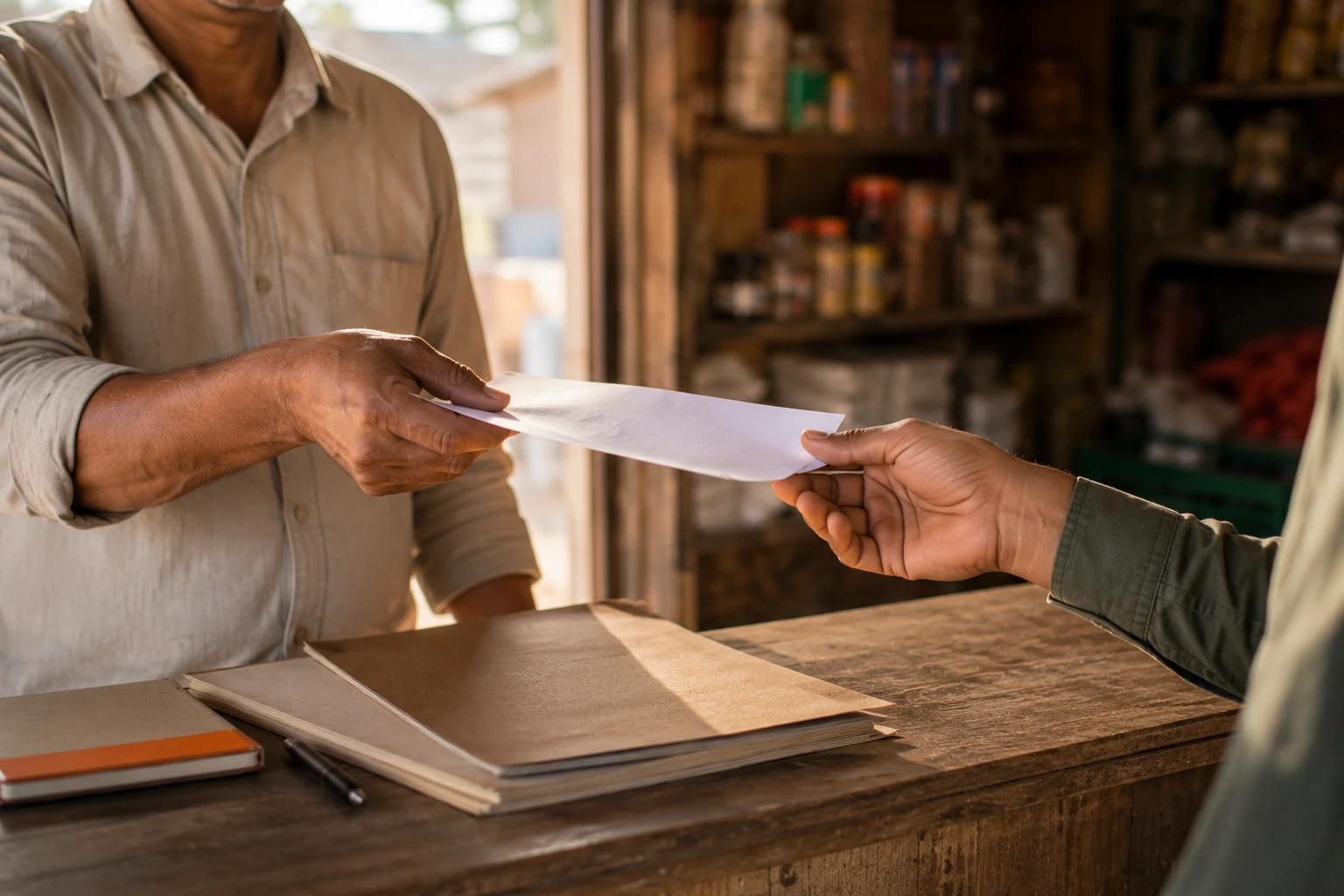
After a few weeks of readings, enough data exists to calculate your natural range — called XmR — the pattern your own numbers actually follow, worked out from your own history, not a guess. This is the moment the framework starts doing its real job: telling the difference between a normal bad week and a genuine warning sign.
From this point on, you have two things watching for you at once: the threshold you chose on Day 1, and the pattern your own business just revealed about itself. And because the readings are already there, you can also print a proof report right now — a record showing consistent, in-limit performance, ready the moment a bank or a buyer asks for it.
Dit is slechts ter illustratie — uw eigen wekelijkse metingen, uw eigen grenswaarden, berekend op basis van uw eigen geschiedenis.
Dit is waar het je daadwerkelijk helpt om beter te worden.
Here is what that looks like in practice. Take the Farmer from earlier. For months, weekly yield readings sit comfortably inside the natural range XmR calculated back in Month 1 — some weeks a little higher, some lower, all normal variation. Then, over three weeks, readings start drifting down. Not dramatically. Not yet below the CPL threshold. But the shape doesn't look like the usual up-and-down anymore — it looks like a trend.
That shape is the whole point. A single bad week means nothing on its own. A trend means something changed. Instead of finding out three months later when the season's income is visibly down, the Farmer sees it in week three and asks the right question early: what changed around here? Looking back, the irrigation schedule shifted after a pump was replaced two weeks before the drift started. Not a guess — a specific, dated, checkable cause, found because the timing lined up with the farmer's own readings, not with memory.
The irrigation timing gets adjusted back. The next few weeks' readings are the test: if the cause was right, yield recovers into the normal range again. It does. That recovery is confirmed by the exact same signal that caught the problem — not a hope that the fix worked, a checked one.
That loop — catch it early, find the real cause, fix it, confirm the fix worked — is what MetriqOne is actually for. The record this builds along the way never disappears either: nothing is deleted or overwritten, and if you pause for a season, everything is waiting exactly as you left it. A year from now, that record also happens to be exactly what a bank or a buyer wants to see. But that was never the main event — getting better at what you do, one caught problem at a time, is.
Wat je daadwerkelijk bereikt
Je pakt problemen aan terwijl ze nog klein zijn.
Je eigen drempelwaarde en je eigen natuurlijke tolerantiebereik houden tegelijkertijd de situatie in de gaten — wekenlange waarschuwing in plaats van een verrassing, zoals de boer de opbrengstafwijking hierboven al opmerkte.
Je vindt de werkelijke oorzaak, geen gissing.
Een signaal wijst op het moment waarop de dingen veranderden. Door dat te vergelijken met wat er rond die tijd daadwerkelijk gebeurde, wordt "er klopt iets niet" een specifieke, oplosbare oorzaak.
Een bank kijkt naar een staat van dienst, niet naar een belofte.
Een leningaanvraag ondersteund door een schriftelijk bewijs van consistente prestaties binnen de kredietlimiet – geen zelf opgestelde winst- en verliesrekening.
Een koper ziet bewijs, geen verkooppraatje.
Een leveringscontract of doorlopende opdracht, ondersteund door bewijs dat u betrouwbaar levert, onder uw eigen voorwaarden.
Je bezit er alles van.
Geen enkel hoofdkantoor leest uw gegevens, tenzij u ervoor kiest deze te delen. Uw account, uw signaal, uw bewijs op papier.
Geen smartphone? Geen probleem.
Node-Business — een winkel die je al kent
An existing print shop, cooperative office, or market desk — somewhere you already trust — registers you, prints your forms, submits them for you, and prints your proof report whenever you need it. Paper in, proof out. No app, no data plan, no new habit to learn.
Hoe Node-Businesses werken →Je doet het werk al. Begin het patroon te herkennen.
Nothing about your business needs to change. What changes is whether you can catch the moment something drifts, understand why, and fix it — before it costs you a season. Proof for a bank or a buyer comes along with that, but it was never the point. Getting better at what you already do is. That starts with a Day 1.
Aan de slag