Para pequeñas empresas
Tu negocio tiene un patrón. La mayoría de los dueños nunca llegan a verlo.
A good week and a bad week feel the same in the moment — you just keep working. Without a record, you can't tell the difference between normal ups and downs and something actually going wrong, until it's already a problem. MetriqOne's whole purpose is showing you that difference early enough to do something about it.
That is the main thing it does: read your own numbers back to you in a way that catches drift while it's still small, so you can find the real cause and fix it — before a bad month becomes a bad year. A printed, dated record of how your business performs comes along with that, almost as a side effect — and it happens to be exactly what a bank or a buyer wants to see. Here is what actually happens, week by week.

Tres empresas. El mismo punto de partida.
Trabajos diferentes, mismo problema: imposible distinguir una variación normal de una señal de alerta real, y nada por escrito en lo que un banco o un comprador confiarían. Analizaremos los tres casos hasta ver qué sucede realmente.

El comerciante
Compra y vende mercancías en un mercado o al otro lado de la frontera. Realiza transacciones todas las semanas. No hay nada escrito al respecto.

El granjero
Cultiva y vende productos en ciclos fijos. El rendimiento varía. No existe ningún registro de cómo es un rendimiento "normal".

El taller
Fabrica o repara artículos por encargo. Realiza entregas puntuales. Nunca había tenido que demostrárselo a nadie, hasta ahora.
Lo que realmente sucede — Semana a semana
Usted se registra y usted decide qué significa "multa".
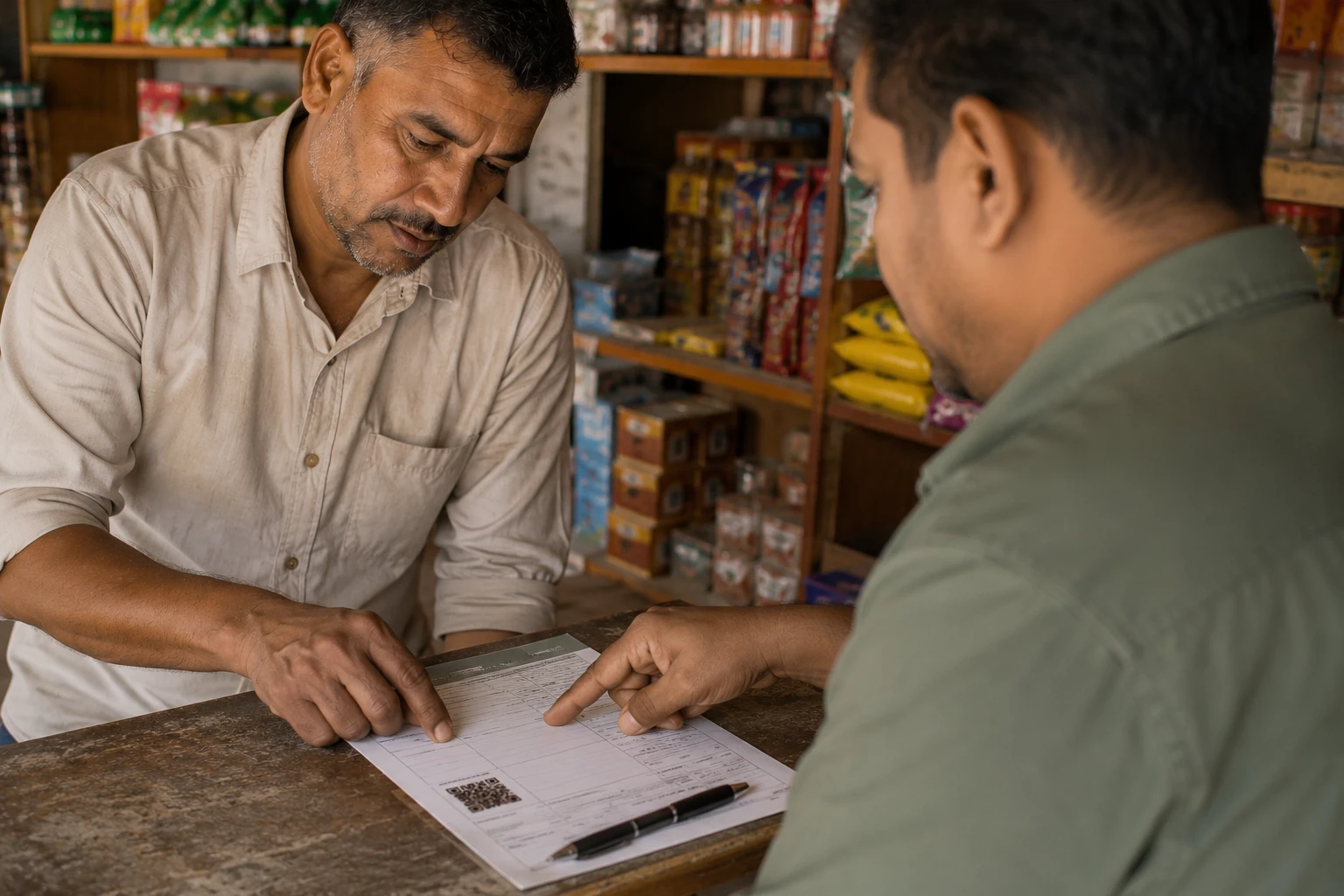
You register once, either yourself with a smartphone, or through a local print shop or cooperative office that does it for you on paper — this is called a Node-Business, and it exists specifically for people without a smartphone or reliable internet. Either way, you become a Member Operator on your own account, called a Field account: it belongs to you, not to anyone above you.
You answer a few honest questions about your business — what it actually is, what's working against it right now, what "doing fine" looks like in your own terms. You also set one number — a threshold you choose — below which you want to know something's wrong. This is called your CPL. No one sets it for you. You know your business; the number is yours.
Envía lo que ya estás haciendo.
Once a week — or however often makes sense for your business — you record a few real numbers from your own work. On the app if you have one. On paper, submitted through your Node-Business, if you don't. No new work. Just writing down what you already know.
Ves tu propio patrón por primera vez.

After a few weeks of readings, enough data exists to calculate your natural range — called XmR — the pattern your own numbers actually follow, worked out from your own history, not a guess. This is the moment the framework starts doing its real job: telling the difference between a normal bad week and a genuine warning sign.
From this point on, you have two things watching for you at once: the threshold you chose on Day 1, and the pattern your own business just revealed about itself. And because the readings are already there, you can also print a proof report right now — a record showing consistent, in-limit performance, ready the moment a bank or a buyer asks for it.
A título meramente ilustrativo: sus propias lecturas semanales, sus propios límites, calculados a partir de su propio historial.
Aquí es donde realmente te ayuda a mejorar.
Here is what that looks like in practice. Take the Farmer from earlier. For months, weekly yield readings sit comfortably inside the natural range XmR calculated back in Month 1 — some weeks a little higher, some lower, all normal variation. Then, over three weeks, readings start drifting down. Not dramatically. Not yet below the CPL threshold. But the shape doesn't look like the usual up-and-down anymore — it looks like a trend.
That shape is the whole point. A single bad week means nothing on its own. A trend means something changed. Instead of finding out three months later when the season's income is visibly down, the Farmer sees it in week three and asks the right question early: what changed around here? Looking back, the irrigation schedule shifted after a pump was replaced two weeks before the drift started. Not a guess — a specific, dated, checkable cause, found because the timing lined up with the farmer's own readings, not with memory.
The irrigation timing gets adjusted back. The next few weeks' readings are the test: if the cause was right, yield recovers into the normal range again. It does. That recovery is confirmed by the exact same signal that caught the problem — not a hope that the fix worked, a checked one.
That loop — catch it early, find the real cause, fix it, confirm the fix worked — is what MetriqOne is actually for. The record this builds along the way never disappears either: nothing is deleted or overwritten, and if you pause for a season, everything is waiting exactly as you left it. A year from now, that record also happens to be exactly what a bank or a buyer wants to see. But that was never the main event — getting better at what you do, one caught problem at a time, is.
Lo que realmente logras
Detecta los problemas cuando aún son pequeños.
Tu propio umbral y tu propio rango natural se ven afectados simultáneamente: semanas de aviso en lugar de una sorpresa, como le sucedió al agricultor con la variación en el rendimiento descrita anteriormente.
Encontrarás la causa real, no una suposición.
Una señal indica cuándo cambiaron las cosas. Comparar esa señal con lo que realmente sucedió en ese momento convierte la percepción de que "algo no funciona bien" en una causa específica y solucionable.
Un banco valora el historial, no las promesas.
Una solicitud de préstamo respaldada por un historial impreso de desempeño constante y dentro de los límites establecidos, no por un estado de resultados redactado por el propio solicitante.
Un comprador ve pruebas, no una propuesta.
Un contrato de suministro o un pedido permanente respaldado por pruebas de que usted realiza las entregas de forma fiable y en sus propios términos.
Eres dueño de cada pedazo de ello.
Ninguna oficina central lee tus datos a menos que decidas compartirlos. Tu cuenta, tu señal, tu comprobante impreso.
¿No tienes smartphone? No hay problema.
Node-Business : una tienda que ya conoces.
An existing print shop, cooperative office, or market desk — somewhere you already trust — registers you, prints your forms, submits them for you, and prints your proof report whenever you need it. Paper in, proof out. No app, no data plan, no new habit to learn.
Cómo funcionan los negocios basados en nodos →Ya haces el trabajo. Empieza a ver el patrón.
Nothing about your business needs to change. What changes is whether you can catch the moment something drifts, understand why, and fix it — before it costs you a season. Proof for a bank or a buyer comes along with that, but it was never the point. Getting better at what you already do is. That starts with a Day 1.
Comience