Untuk Perniagaan Kecil
Perniagaan Anda Mempunyai Corak. Kebanyakan Pemilik Tidak Pernah Berpeluang Melihatnya.
A good week and a bad week feel the same in the moment — you just keep working. Without a record, you can't tell the difference between normal ups and downs and something actually going wrong, until it's already a problem. MetriqOne's whole purpose is showing you that difference early enough to do something about it.
That is the main thing it does: read your own numbers back to you in a way that catches drift while it's still small, so you can find the real cause and fix it — before a bad month becomes a bad year. A printed, dated record of how your business performs comes along with that, almost as a side effect — and it happens to be exactly what a bank or a buyer wants to see. Here is what actually happens, week by week.

Tiga Perniagaan. Titik Permulaan yang Sama.
Kerja berbeza, jurang yang sama: tiada cara untuk membezakan variasi normal daripada tanda amaran sebenar, dan tiada apa yang tertulis yang boleh dipercayai oleh bank atau pembeli. Kita akan mengikuti ketiga-tiga perkara ini sehingga apa yang sebenarnya berlaku.

Pedagang
Membeli dan menjual barang di pasar atau merentasi sempadan. Berniaga setiap minggu. Tiada apa-apa di atas kertas yang menyatakannya.

Petani
Menanam dan menjual hasil pada kitaran tetap. Hasil berbeza-beza. Tiada rekod tentang rupa "normal".

Bengkel
Membuat atau membaiki barang mengikut pesanan. Menghantar dengan andal. Tidak pernah perlu membuktikannya kepada sesiapa pun — sehingga kini.
Apa yang Sebenarnya Berlaku — Minggu demi Minggu
Anda Mendaftar — dan Anda Memutuskan Apa Maksud "Dendam"
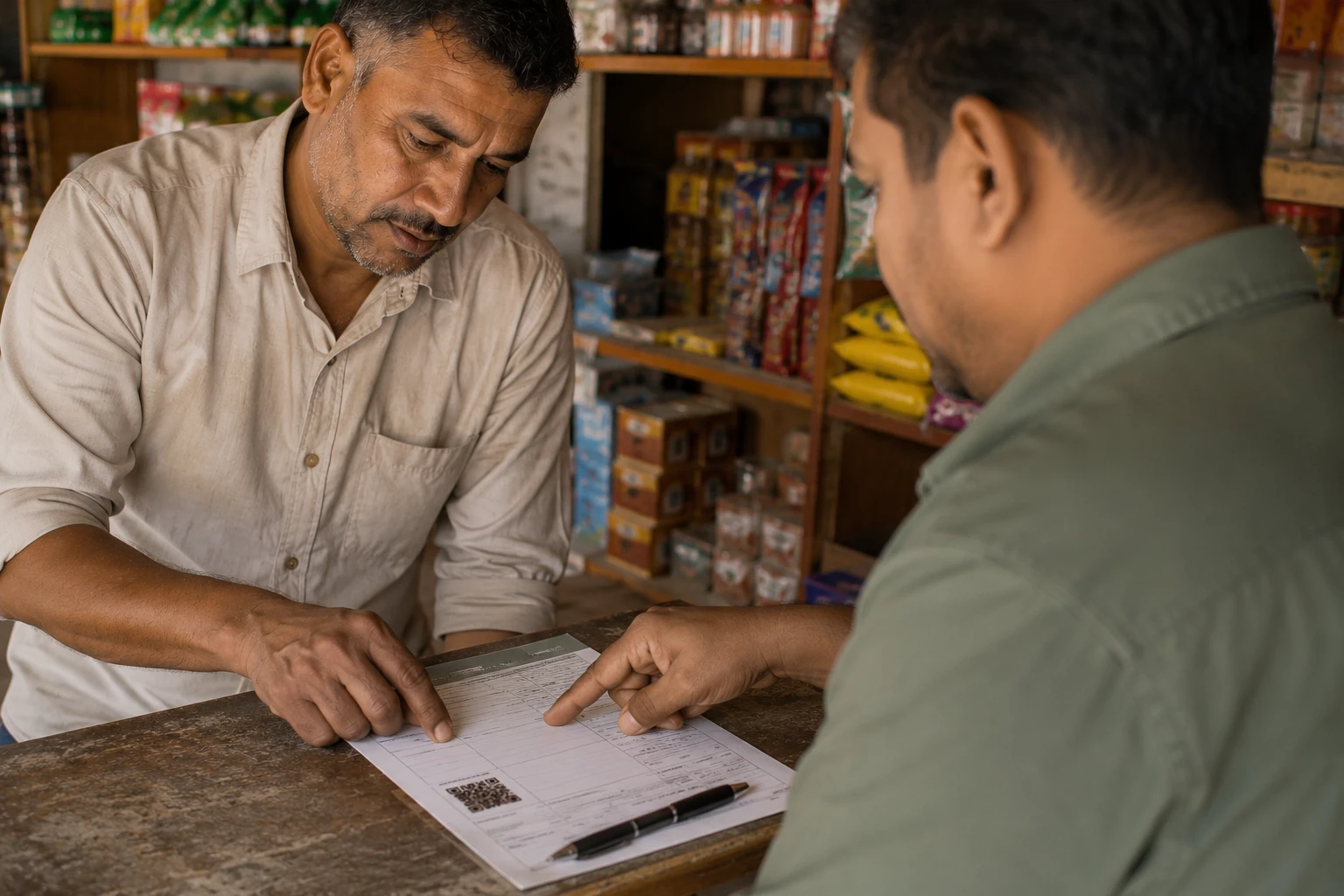
You register once, either yourself with a smartphone, or through a local print shop or cooperative office that does it for you on paper — this is called a Node-Business, and it exists specifically for people without a smartphone or reliable internet. Either way, you become a Member Operator on your own account, called a Field account: it belongs to you, not to anyone above you.
You answer a few honest questions about your business — what it actually is, what's working against it right now, what "doing fine" looks like in your own terms. You also set one number — a threshold you choose — below which you want to know something's wrong. This is called your CPL. No one sets it for you. You know your business; the number is yours.
Anda Menyerahkan Apa yang Anda Telah Lakukan
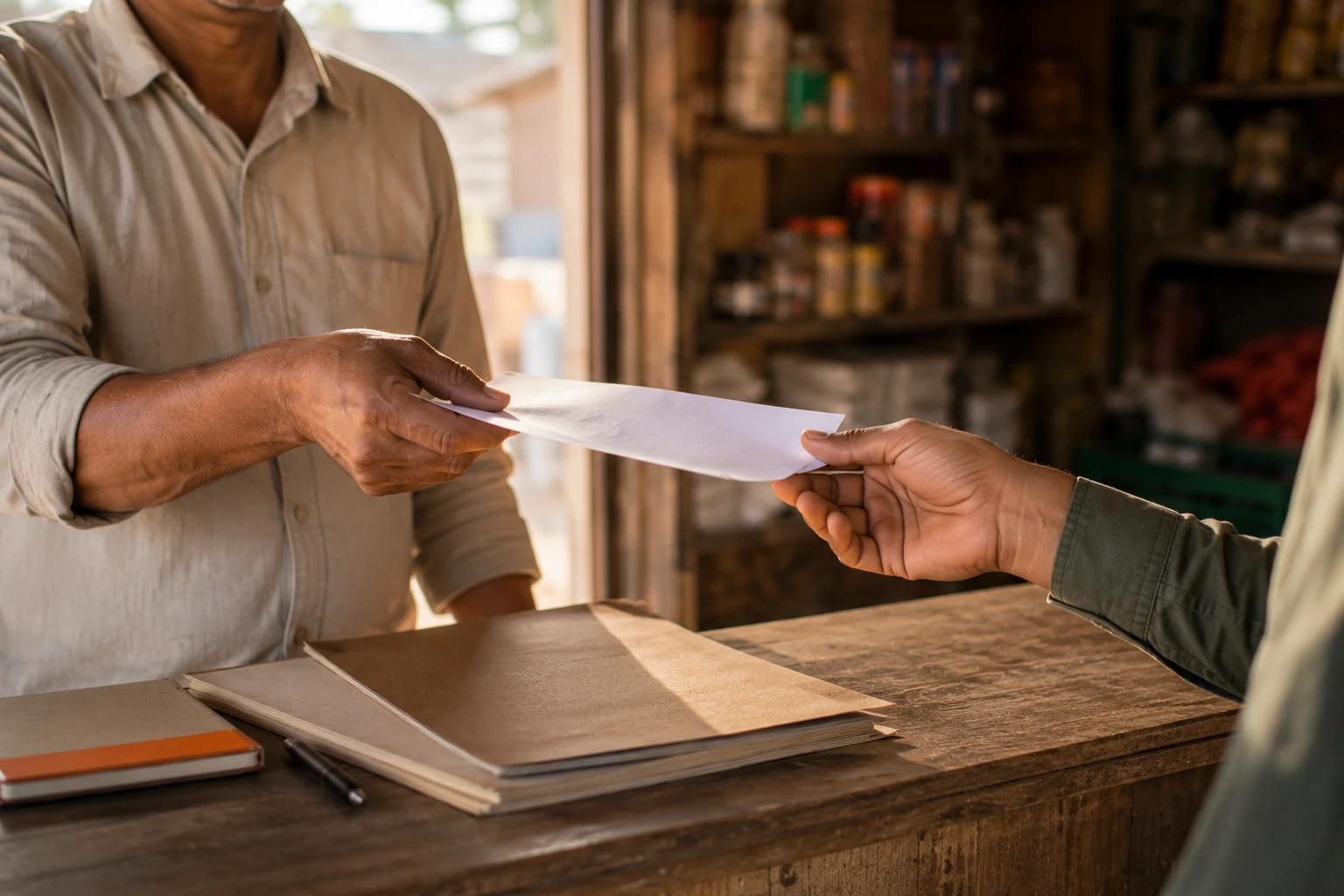
Once a week — or however often makes sense for your business — you record a few real numbers from your own work. On the app if you have one. On paper, submitted through your Node-Business, if you don't. No new work. Just writing down what you already know.
Anda Melihat Corak Anda Sendiri Buat Kali Pertama
After a few weeks of readings, enough data exists to calculate your natural range — called XmR — the pattern your own numbers actually follow, worked out from your own history, not a guess. This is the moment the framework starts doing its real job: telling the difference between a normal bad week and a genuine warning sign.
From this point on, you have two things watching for you at once: the threshold you chose on Day 1, and the pattern your own business just revealed about itself. And because the readings are already there, you can also print a proof report right now — a record showing consistent, in-limit performance, ready the moment a bank or a buyer asks for it.
Ilustrasi sahaja — bacaan mingguan anda sendiri, garis had anda sendiri, dikira daripada sejarah anda sendiri.
Di Sinilah Ia Sebenarnya Membantu Anda Menjadi Lebih Baik
Here is what that looks like in practice. Take the Farmer from earlier. For months, weekly yield readings sit comfortably inside the natural range XmR calculated back in Month 1 — some weeks a little higher, some lower, all normal variation. Then, over three weeks, readings start drifting down. Not dramatically. Not yet below the CPL threshold. But the shape doesn't look like the usual up-and-down anymore — it looks like a trend.
That shape is the whole point. A single bad week means nothing on its own. A trend means something changed. Instead of finding out three months later when the season's income is visibly down, the Farmer sees it in week three and asks the right question early: what changed around here? Looking back, the irrigation schedule shifted after a pump was replaced two weeks before the drift started. Not a guess — a specific, dated, checkable cause, found because the timing lined up with the farmer's own readings, not with memory.
The irrigation timing gets adjusted back. The next few weeks' readings are the test: if the cause was right, yield recovers into the normal range again. It does. That recovery is confirmed by the exact same signal that caught the problem — not a hope that the fix worked, a checked one.
That loop — catch it early, find the real cause, fix it, confirm the fix worked — is what MetriqOne is actually for. The record this builds along the way never disappears either: nothing is deleted or overwritten, and if you pause for a season, everything is waiting exactly as you left it. A year from now, that record also happens to be exactly what a bank or a buyer wants to see. But that was never the main event — getting better at what you do, one caught problem at a time, is.
Apa yang Anda Capai Sebenarnya
Anda menemui masalah semasa ia masih kecil
Ambang batas dan julat semula jadi anda sendiri, kedua-duanya memerhati sekaligus — berminggu-minggu memberi amaran dan bukannya mengejutkan, cara Petani menangkap hanyutan hasil di atas.
Anda mencari punca sebenar, bukan sekadar tekaan
Isyarat menunjukkan bila keadaan berubah. Menghubungkan perkara itu dengan apa yang sebenarnya berlaku sekitar masa itu akan mengubah "sesuatu yang tidak kena" menjadi punca tertentu yang boleh diperbaiki.
Bank melihat rekod prestasi, bukan janji
Permohonan pinjaman yang disokong oleh sejarah bercetak prestasi yang konsisten dan dalam had — bukan penyata pendapatan yang ditulis sendiri.
Pembeli melihat bukti, bukan promosi
Kontrak bekalan atau perintah tetap yang disokong oleh bukti bahawa anda menyampaikannya dengan andal, mengikut terma anda sendiri.
Anda memiliki setiap bahagiannya
Tiada ibu pejabat yang membaca data anda melainkan anda memilih untuk berkongsinya. Akaun anda, isyarat anda, bukti bercetak anda.
Tiada Telefon Pintar? Tiada Masalah.
Node-Business — kedai yang anda sudah tahu
An existing print shop, cooperative office, or market desk — somewhere you already trust — registers you, prints your forms, submits them for you, and prints your proof report whenever you need it. Paper in, proof out. No app, no data plan, no new habit to learn.
Cara Perniagaan Nod berfungsi →Anda Sudah Melakukan Kerja. Mula Melihat Coraknya.
Nothing about your business needs to change. What changes is whether you can catch the moment something drifts, understand why, and fix it — before it costs you a season. Proof for a bank or a buyer comes along with that, but it was never the point. Getting better at what you already do is. That starts with a Day 1.
Mulakan